The Reason I Left Mullingar Lyrics And Chords
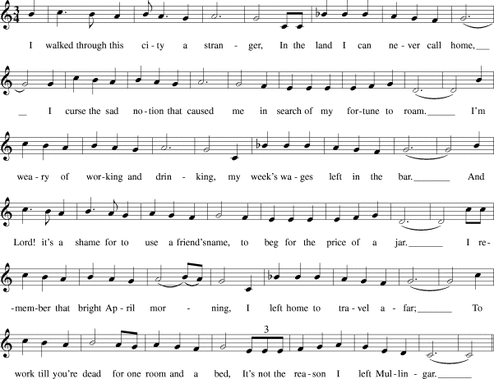
Pat Cooksky wrote this song. Made famous by The Furey Brothers And Davie Arthur [ songs ]. An Irish folk song about emigration from Ireland in the 1980s to London where many an Irish person went looking for work. The sheet music notes are included. For those who don't already know, Mullingar is a town in Co. Westmeath in Ireland.
I[Em] walked through this[D] city a[C] stran[G]ger,
in a[F] land I can[C] never call[G] hom[D]e,
And I[Em] cursed the sad[D] notion that[C] caused[G] me,
in[Em] search of my fortune toD] rome.
[2]
Im weary of working and drinking,
a week's wages left by the bar,
And Lord it's a shame to use a friends name,
to beg for the price of a jar.
[Chorus]
I[Em] remember that[D] bright april[C] mor[G]ning,
when I[F] left home to[C] travel[G] a-[D]far,
To[Em] work till your[D] dead for a[C] room and a[G] bed,
It's not the[G] reason I[D] left Mullin[G]gar.
[3]
Oh this London's a city of heartbreak,
on friday there's friends by the score,
But when the pay's finished on monday,
a friend's not your friend anymore.
[4]
Oh a working day seems never ending,
from a shovel and pick there's no break,
But when your not working your spending,
that fortune you left home to make.
[5]
And for everyone here that finds fortune,
and comes home to tell of the tale,
Each morning the broadway is crowed,
with many's the thousant that failed.
[6]
So young men of Ireland take warning,
in London you never will find,
The gold at the end of the rainbow,
you might just have left it behind.
in a[F] land I can[C] never call[G] hom[D]e,
And I[Em] cursed the sad[D] notion that[C] caused[G] me,
in[Em] search of my fortune toD] rome.
[2]
Im weary of working and drinking,
a week's wages left by the bar,
And Lord it's a shame to use a friends name,
to beg for the price of a jar.
[Chorus]
I[Em] remember that[D] bright april[C] mor[G]ning,
when I[F] left home to[C] travel[G] a-[D]far,
To[Em] work till your[D] dead for a[C] room and a[G] bed,
It's not the[G] reason I[D] left Mullin[G]gar.
[3]
Oh this London's a city of heartbreak,
on friday there's friends by the score,
But when the pay's finished on monday,
a friend's not your friend anymore.
[4]
Oh a working day seems never ending,
from a shovel and pick there's no break,
But when your not working your spending,
that fortune you left home to make.
[5]
And for everyone here that finds fortune,
and comes home to tell of the tale,
Each morning the broadway is crowed,
with many's the thousant that failed.
[6]
So young men of Ireland take warning,
in London you never will find,
The gold at the end of the rainbow,
you might just have left it behind.
Guitar chords for all verses.
[Verse 1]
I [Em]walked through this [D]city a [C]stran[G]ger,
In a [F]land I can [C]never call [G]home [D],
And I [Em]cursed the sad [D]notion that [C]caused [G]me,
In [Em]search of my [D]fortune to [G]roam.
[Verse 2]
I'm [Em]weary of [D]working and [C]drin[G]king,
A [F]week’s wages [C]left by the [G]bar [D],
And [Em]Lord it's a [D]shame to use [C]a friend's [G]name,
To [Em]beg for the [D]price of a [G]jar.
[Chorus]
I [Em]remember that [D]bright April [C]mor[G]ning,
When I [F]left home to [C]travel a[G]far [D],
To [Em]work till you're [D]dead for a [C]room and a [G]bed,
It's not the [G]reason I [D]left Mullin[G]gar.
[Verse 3]
Oh this [Em]London’s a [D]city of [C]heart[G]break,
On [F]Friday there’s [C]friends by the [G]score [D],
But [Em]when the pay’s [D]finished on [C]Mon[G]day,
A [Em]friend’s not your [D]friend any[G]more.
[Verse 4]
Oh a [Em]working day [D]seems never [C]end[G]ing,
From a [F]shovel and [C]pick there’s no [G]break [D],
But [Em]when you’re not [D]working you’re [C]spend[G]ing,
That [Em]fortune you [D]left home to [G]make.
[Verse 5]
And for [Em]everyone [D]here that finds [C]for[G]tune,
And [F]comes home to [C]tell of the [G]tale [D],
Each [Em]morning the [D]Broadway is [C]crowd[G]ed,
With [Em]many’s the [D]thousand that [G]failed.
[Verse 6]
So [Em]young men of [D]Ireland take [C]warn[G]ing,
In [F]London you [C]never will [G]find [D],
The [Em]gold at the [D]end of the [C]rain[G]bow,
You [Em]might just have [D]left it be[G]hind.
Notes:
[Verse 1]
I [Em]walked through this [D]city a [C]stran[G]ger,
In a [F]land I can [C]never call [G]home [D],
And I [Em]cursed the sad [D]notion that [C]caused [G]me,
In [Em]search of my [D]fortune to [G]roam.
[Verse 2]
I'm [Em]weary of [D]working and [C]drin[G]king,
A [F]week’s wages [C]left by the [G]bar [D],
And [Em]Lord it's a [D]shame to use [C]a friend's [G]name,
To [Em]beg for the [D]price of a [G]jar.
[Chorus]
I [Em]remember that [D]bright April [C]mor[G]ning,
When I [F]left home to [C]travel a[G]far [D],
To [Em]work till you're [D]dead for a [C]room and a [G]bed,
It's not the [G]reason I [D]left Mullin[G]gar.
[Verse 3]
Oh this [Em]London’s a [D]city of [C]heart[G]break,
On [F]Friday there’s [C]friends by the [G]score [D],
But [Em]when the pay’s [D]finished on [C]Mon[G]day,
A [Em]friend’s not your [D]friend any[G]more.
[Verse 4]
Oh a [Em]working day [D]seems never [C]end[G]ing,
From a [F]shovel and [C]pick there’s no [G]break [D],
But [Em]when you’re not [D]working you’re [C]spend[G]ing,
That [Em]fortune you [D]left home to [G]make.
[Verse 5]
And for [Em]everyone [D]here that finds [C]for[G]tune,
And [F]comes home to [C]tell of the [G]tale [D],
Each [Em]morning the [D]Broadway is [C]crowd[G]ed,
With [Em]many’s the [D]thousand that [G]failed.
[Verse 6]
So [Em]young men of [D]Ireland take [C]warn[G]ing,
In [F]London you [C]never will [G]find [D],
The [Em]gold at the [D]end of the [C]rain[G]bow,
You [Em]might just have [D]left it be[G]hind.
Notes:
- Chords used: Em, D, C, G, F (optional: substitute F → Dm if you prefer all open chords).
- Time signature: 4/4, slow to moderate ballad tempo (♩ ≈ 80–90).
- Strumming pattern: Down – down-up – up-down-up, or fingerpicked arpeggios.
- Works beautifully with capo 2 (sounds in A minor) for higher voices.
Guitar chords for the key of Am.
I [Am]walked through this [G]city a [F]stran[C]ger,
In a [A#]land I can [F]never call [C]home [G],
And I [Am]cursed the sad [G]notion that [F]caused [C]me,
In [Am]search of my [G]fortune to [C]roam.
I'm [Am]weary of [G]working and [F]drin[C]king,
A [A#]week's wages [F]left by the [C]bar [G],
And [Am]Lord it's a [G]shame to use [F]a friend's [C]name,
To [Am]beg for the [G]price of a [C]jar.
I [Am]remember that [G]bright April [F]mor[C]ning,
When I [A#]left home to [F]travel a[C]far [G],
To [Am]work till you're [G]dead for a [F]room and a [C]bed,
It's not the [C]reason I [G]left Mullin[C]gar.
Oh this [Am]London's a [G]city of [F]heart[C]break,
On [A#]Friday there's [F]friends by the [C]score [G],
But [Am]when the pay's [G]finished on [F]Mon[C]day,
A [Am]friend's not your [G]friend any[C]more.
Oh a [Am]working day [G]seems never [F]end[C]ing,
From a [A#]shovel and [F]pick there's no [C]break [G],
But [Am]when you're not [G]working you're [F]spend[C]ing,
That [Am]fortune you [G]left home to [C]make.
And for [Am]everyone [G]here that finds [F]for[C]tune,
And [A#]comes home to [F]tell of the [C]tale [G],
Each [Am]morning the [G]Broadway is [F]crowd[C]ed,
With [Am]many's the [G]thousand that [C]failed.
So [Am]young men of [G]Ireland take [F]warn[C]ing,
In [A#]London you [F]never will [C]find [G],
The [Am]gold at the [G]end of the [F]rain[C]bow,
You [Am]might just have [G]left it be[C]hind.
I [Am]walked through this [G]city a [F]stran[C]ger,
In a [A#]land I can [F]never call [C]home [G],
And I [Am]cursed the sad [G]notion that [F]caused [C]me,
In [Am]search of my [G]fortune to [C]roam.
I'm [Am]weary of [G]working and [F]drin[C]king,
A [A#]week's wages [F]left by the [C]bar [G],
And [Am]Lord it's a [G]shame to use [F]a friend's [C]name,
To [Am]beg for the [G]price of a [C]jar.
I [Am]remember that [G]bright April [F]mor[C]ning,
When I [A#]left home to [F]travel a[C]far [G],
To [Am]work till you're [G]dead for a [F]room and a [C]bed,
It's not the [C]reason I [G]left Mullin[C]gar.
Oh this [Am]London's a [G]city of [F]heart[C]break,
On [A#]Friday there's [F]friends by the [C]score [G],
But [Am]when the pay's [G]finished on [F]Mon[C]day,
A [Am]friend's not your [G]friend any[C]more.
Oh a [Am]working day [G]seems never [F]end[C]ing,
From a [A#]shovel and [F]pick there's no [C]break [G],
But [Am]when you're not [G]working you're [F]spend[C]ing,
That [Am]fortune you [G]left home to [C]make.
And for [Am]everyone [G]here that finds [F]for[C]tune,
And [A#]comes home to [F]tell of the [C]tale [G],
Each [Am]morning the [G]Broadway is [F]crowd[C]ed,
With [Am]many's the [G]thousand that [C]failed.
So [Am]young men of [G]Ireland take [F]warn[C]ing,
In [A#]London you [F]never will [C]find [G],
The [Am]gold at the [G]end of the [F]rain[C]bow,
You [Am]might just have [G]left it be[C]hind.
The Sheet Music
🍀 The Reason I Left Mullingar
Performed by: The Furey Brothers and Davey Arthur
Genre: Irish folk / ballad
Themes: Emigration, poverty, disillusionment, working-class pride
First Recorded: Late 1970s (appears on Emigrant and various live albums)
🎵 Overview
“The Reason I Left Mullingar” is a modern Irish folk song that perfectly captures the economic hardship and forced emigration faced by thousands of Irish people in the 20th century.
Performed with sincerity by Finbar and Eddie Furey, and accompanied by the warm, intricate guitar work of Davey Arthur, the song became one of the group’s defining numbers.
It’s not a rebel song, but rather a song of quiet rebellion — against poverty, hypocrisy, and the lack of opportunity that forced so many Irish men and women to leave home.
🎶 Musical Style
Key: D major (typically)
Time Signature: 3/4 or slow 6/8 (a waltz-like rhythm)
Tempo: Slow, reflective
Instrumentation:
Guitar (Davey Arthur’s signature arpeggio picking)
Tin whistle and low whistle
Accordion / fiddle
Soft bodhrán or brushed snare
The tune carries a gentle sadness, yet it’s filled with hope and dignity — a hallmark of The Furey Brothers’ sound. Finbar Furey’s haunting voice and uilleann pipe playing amplify the melancholy tone.
🪕 About The Furey Brothers and Davey Arthur
The Furey Brothers — Finbar, Eddie, George, and Paul — were among Ireland’s most popular folk groups from the 1970s onward.
When they teamed up with Scottish-born musician Davey Arthur, their sound became richer and more distinctive, blending traditional Irish instrumentation with contemporary folk songwriting.
Songs like “When You Were Sweet Sixteen”, “The Green Fields of France”, and “The Reason I Left Mullingar” showed that they could balance deep emotion with social commentary, and bring those stories to life in a way few other folk acts could.
Performed by: The Furey Brothers and Davey Arthur
Genre: Irish folk / ballad
Themes: Emigration, poverty, disillusionment, working-class pride
First Recorded: Late 1970s (appears on Emigrant and various live albums)
🎵 Overview
“The Reason I Left Mullingar” is a modern Irish folk song that perfectly captures the economic hardship and forced emigration faced by thousands of Irish people in the 20th century.
Performed with sincerity by Finbar and Eddie Furey, and accompanied by the warm, intricate guitar work of Davey Arthur, the song became one of the group’s defining numbers.
It’s not a rebel song, but rather a song of quiet rebellion — against poverty, hypocrisy, and the lack of opportunity that forced so many Irish men and women to leave home.
🎶 Musical Style
Key: D major (typically)
Time Signature: 3/4 or slow 6/8 (a waltz-like rhythm)
Tempo: Slow, reflective
Instrumentation:
Guitar (Davey Arthur’s signature arpeggio picking)
Tin whistle and low whistle
Accordion / fiddle
Soft bodhrán or brushed snare
The tune carries a gentle sadness, yet it’s filled with hope and dignity — a hallmark of The Furey Brothers’ sound. Finbar Furey’s haunting voice and uilleann pipe playing amplify the melancholy tone.
🪕 About The Furey Brothers and Davey Arthur
The Furey Brothers — Finbar, Eddie, George, and Paul — were among Ireland’s most popular folk groups from the 1970s onward.
When they teamed up with Scottish-born musician Davey Arthur, their sound became richer and more distinctive, blending traditional Irish instrumentation with contemporary folk songwriting.
Songs like “When You Were Sweet Sixteen”, “The Green Fields of France”, and “The Reason I Left Mullingar” showed that they could balance deep emotion with social commentary, and bring those stories to life in a way few other folk acts could.