Irish folk songs
  • Home
  • Lyrics And Chords
  • Tin Whistle Song Book
  • Tin Whistle

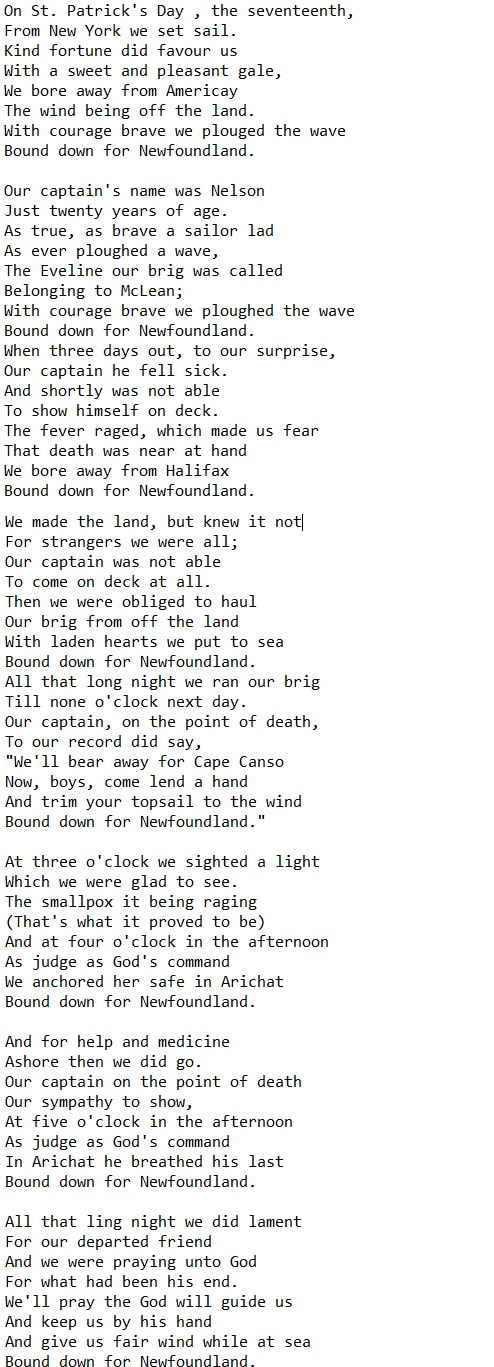
Bound Down For Newfoundland lyrics and chords

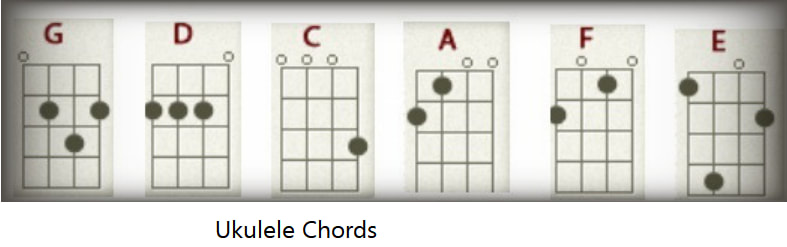
[A]On St. Patrick's Day [ song ], the[D] seventeenth,
From[A] New York[E] we set[A] sail.
Kind fortune did[E] favour[A] us
With a sweet and pleasant[E] gale,
We[A] bore away from A[E]meri[A]cay
The wind being off the[E] land.
With[A] courage brave we[D] plouged the wave
Bound[A] down for [E]Newfound[A]land.
 
Our captain's name was Nelson
Just twenty years of age.
As true, as brave a sailor lad
As ever ploughed a wave,
The Eveline our brig was called
Belonging to McLean;
With courage brave we ploughed the wave
Bound down for Newfoundland.
When three days out, to our surprise,
Our captain he fell sick.
And shortly was not able
To show himself on deck.
The fever raged, which made us fear
That death was near at hand
We bore away from Halifax
Bound down for Newfoundland.
 
We made the land, but knew it not
For strangers we were all;
Our captain was not able
To come on deck at all.
Then we were obliged to haul
Our brig from off the land
With laden hearts we put to sea
Bound down for Newfoundland.
All that long night we ran our brig
Till none o'clock next day.
Our captain, on the point of death,
To our record did say,
"We'll bear away for Cape Canso
Now, boys, come lend a hand
And trim your topsail to the wind
Bound down for Newfoundland."
 
At three o'clock we sighted a light
Which we were glad to see.
The smallpox it being raging
(That's what it proved to be)
And at four o'clock in the afternoon
As judge as God's command
We anchored her safe in Arichat
Bound down for Newfoundland.
 
And for help and medicine
Ashore then we did go.
Our captain on the point of death
Our sympathy to show,
At five o'clock in the afternoon
As judge as God's command
In Arichat he breathed his last
Bound down for Newfoundland.
 
All that ling night we did lament
For our departed friend
And we were praying unto God
For what had been his end.
We'll pray the God will guide us
And keep us by his hand
And give us fair wind while at sea
Bound down for Newfoundland.

​
“Bound Down for Newfoundland” with chords placed on all verses and a fitting strumming pattern.
This version is in A Major, keeping the traditional folk rhythm and maritime feel.

🎵 Bound Down for Newfoundland

Key: A Major
Tempo: Moderate (folk ballad / sea shanty)
Time Signature: 4/4

🎸 Strumming Pattern (4/4):

Down ↓ Down ↑ Up Down ↑
Keep it steady — emphasize the first Down on each measure.
Think of a rhythmic sailing motion, like waves:
Down (pause) Down-Up (Down-Up)

Verse 1
[A]On St. Patrick's Day, the [D]seventeenth,
From [A]New York [E]we set [A]sail.
Kind fortune did [E]favour [A]us
With a sweet and pleasant [E]gale,
We [A]bore away from A[E]meri[A]cay
The wind being off the [E]land.
With [A]courage brave we [D]ploughed the wave
Bound [A]down for [E]Newfound[A]land.

Verse 2
Our [A]captain's name was [D]Nelson,
Just [A]twenty [E]years of [A]age.
As true and brave a [E]sailor lad
As [A]ever ploughed a [E]wave.
The [A]Eveline our [E]brig was [A]called,
Belonging to Mc[E]Lean;
With [A]courage brave we [D]ploughed the wave
Bound [A]down for [E]Newfound[A]land.

Verse 3
When [A]three days out, to [D]our surprise,
Our [A]captain he [E]fell [A]sick.
And shortly was not [E]able
To [A]show himself on [E]deck.
The [A]fever raged, which [E]made us [A]fear
That death was near at [E]hand.
We [A]bore away from [D]Halifax
Bound [A]down for [E]Newfound[A]land.

Verse 4
We [A]made the land, but [D]knew it not,
For [A]strangers [E]we were [A]all;
Our captain was not [E]able
To [A]come on deck at [E]all.
Then [A]we were obliged to [E]haul
Our [A]brig from off the [E]land,
With [A]laden hearts we [D]put to sea
Bound [A]down for [E]Newfound[A]land.

Verse 5
All [A]that long night we [D]ran our brig
Till [A]nine o'clock next [E]day.
Our [A]captain, on the [E]point of death,
To our [A]record did [E]say:
"We'll [A]bear away for [E]Cape Can[A]so
Now, boys, come lend a [E]hand,
And [A]trim your topsails [D]to the wind,
Bound [A]down for [E]Newfound[A]land."

Verse 6
At [A]three o'clock we [D]sighted a light,
Which [A]we were [E]glad to [A]see.
The smallpox it being [E]raging,
(That's [A]what it proved to [E]be)
And [A]at four o'clock that [E]afterno[A]on,
As judge as God's com[E]mand,
We [A]anchored her safe [D]in Arichat,
Bound [A]down for [E]Newfound[A]land.

Verse 7
For [A]help and medicine [D]ashore
Then [A]we did [E]go.
Our [A]captain on the [E]point of death,
Our [A]sympathy to [E]show.
At [A]five o'clock that [E]afterno[A]on,
As judge as God's com[E]mand,
In [A]Arichat he [D]breathed his last,
Bound [A]down for [E]Newfound[A]land.

Verse 8
All [A]that long night we [D]did lament
For [A]our departed [E]friend,
And [A]we were praying [E]unto God
For [A]what had been his [E]end.
We'll [A]pray that God will [E]guide us,
And [A]keep us by his [E]hand,
And [A]give us fair wind [D]while at sea,
Bound [A]down for [E]Newfound[A]land.

🎸 Outro (optional)

Finish softly:

Strum the final A chord once, let it ring for 4 beats, and hum the last line:
“Bound down for Newfoundland…”

“Bound Down for Newfoundland” to G Major and add a simple but authentic intro and outro picking riff (TAB) that fits the song’s traditional sailing rhythm.

🎶 Bound Down for Newfoundland (Key of G Major)

Tempo: Moderate (folk / sea shanty)
Time Signature: 4/4
Strumming Pattern:

Down ↓ Down-Up ↑ Down-Up ↓
(Steady “rowing” rhythm — accent the first beat like a ship’s sway)

🎸 Intro TAB (Pick once or twice through before verse 1)
   G                 C                 G                 D
e|--3-----3-----3--|--0-----0-----0--|--3-----3-----3--|--2-----2-----2--|
B|--0--0--0--0--1--|--1--1--1--1--1--|--0--0--0--0--3--|--3--3--3--3--3--|
G|--0--0--0--0--0--|--0--0--0--0--0--|--0--0--0--0--2--|--2--2--2--2--2--|
D|--0--0--0--0--2--|--2--2--2--2--2--|--0--0--0--0--0--|--0--0--0--0--0--|
A|--2--2--2--2--3--|--3--3--3--3--3--|--2--2--2--2--0--|-----------------|
E|--3--3--3--3-----|-----------------|--3--3--3--3-----|-----------------|

Lyrics with Chords (Key of G Major)
Verse 1
[G]On St. Patrick's Day, the [C]seventeenth,
From [G]New York [D]we set [G]sail.
Kind fortune did [D]favour [G]us
With a sweet and pleasant [D]gale,
We [G]bore away from A[D]meri[G]cay
The wind being off the [D]land.
With [G]courage brave we [C]ploughed the wave
Bound [G]down for [D]Newfound[G]land.

Verse 2
Our [G]captain's name was [C]Nelson,
Just [G]twenty [D]years of [G]age.
As true and brave a [D]sailor lad
As [G]ever ploughed a [D]wave.
The [G]Eveline our [D]brig was [G]called,
Belonging to Mc[D]Lean;
With [G]courage brave we [C]ploughed the wave
Bound [G]down for [D]Newfound[G]land.

Verse 3
When [G]three days out, to [C]our surprise,
Our [G]captain he [D]fell [G]sick.
And shortly was not [D]able
To [G]show himself on [D]deck.
The [G]fever raged, which [D]made us [G]fear
That death was near at [D]hand.
We [G]bore away from [C]Halifax
Bound [G]down for [D]Newfound[G]land.

Verse 4
We [G]made the land, but [C]knew it not,
For [G]strangers [D]we were [G]all;
Our captain was not [D]able
To [G]come on deck at [D]all.
Then [G]we were obliged to [D]haul
Our [G]brig from off the [D]land,
With [G]laden hearts we [C]put to sea
Bound [G]down for [D]Newfound[G]land.

Verse 5
All [G]that long night we [C]ran our brig
Till [G]nine o'clock next [D]day.
Our [G]captain, on the [D]point of death,
To our [G]record did [D]say:
"We'll [G]bear away for [D]Cape Can[G]so
Now, boys, come lend a [D]hand,
And [G]trim your topsails [C]to the wind,
Bound [G]down for [D]Newfound[G]land."

Verse 6
At [G]three o'clock we [C]sighted a light,
Which [G]we were [D]glad to [G]see.
The smallpox it being [D]raging,
(That's [G]what it proved to [D]be)
And [G]at four o'clock that [D]afterno[G]on,
As judge as God's com[D]mand,
We [G]anchored her safe [C]in Arichat,
Bound [G]down for [D]Newfound[G]land.

Verse 7
For [G]help and medicine [C]ashore
Then [G]we did [D]go.
Our [G]captain on the [D]point of death,
Our [G]sympathy to [D]show.
At [G]five o'clock that [D]afterno[G]on,
As judge as God's com[D]mand,
In [G]Arichat he [C]breathed his last,
Bound [G]down for [D]Newfound[G]land.

Verse 8
All [G]that long night we [C]did lament
For [G]our departed [D]friend,
And [G]we were praying [D]unto God
For [G]what had been his [D]end.
We'll [G]pray that God will [D]guide us,
And [G]keep us by his [D]hand,
And [G]give us fair wind [C]while at sea,
Bound [G]down for [D]Newfound[G]land.

🎸 Outro TAB (same feel as intro – slow & proud)
   G                 C                 G                 G
e|--3-----3-----3--|--0-----0-----0--|--3-----3-----3--|--3-----------3---|
B|--0--0--0--0--1--|--1--1--1--1--1--|--0--0--0--0--0--|--0-----------0---|
G|--0--0--0--0--0--|--0--0--0--0--0--|--0--0--0--0--0--|--0-----------0---|
D|--0--0--0--0--2--|--2--2--2--2--2--|--0--0--0--0--0--|--0-----------0---|
A|--2--2--2--2--3--|--3--3--3--3--3--|--2--2--2--2--2--|--2-----------2---|
E|--3--3--3--3-----|-----------------|--3--3--3--3--3--|--3-----------3---|


Let the final G chord ring for at least two full measures.
End softly, or hit one last Down strum for a classic sea-song finish.​
Picture
The Irish In Newfoundland
Here is a little history of the island called Newfoundland. The Irish were great travellers and during the Christian period they spread the light all across Europe and over the western ocean to the great lands of the West. So they would have known of the islands existence since time began and certainty from St. Brendan’s time. 
 
The Island passed to the British from the French by the Treaty of Utrecht in 1713. In 1765, the governors ordered that no Catholics were to remain on the island over the winter.  They were determined to prevent the Irish from settling the island.  The law stated no idle person should remain during the winter, no Papist, servant, man or woman, shall remain at any place where they did not fish or serve during the summer.  

It was also stated that no more than two men shall dwell in a house during the winter except that of their Protestant masters.  No Papist shall keep a public house or sell liquor by retail.  The masters of servants were acquired to pay their passage home.  

No place in Canada had more sectarian laws than Newfoundland had but their labour was needed for the fisheries so they increased in numbers.  The Irish were hard working and useful and kept coming and remained in spite of proclamations.  

They had not the liberty of the birds of the air to build or repair their nests.  There was forest and rocky soil but they were denied a licence to till it.  The only resource open to them was the sea.  The wealth they won from the stormy ocean was taken from them and spent in other lands leaving them with a scanty existence.  Still the population increased.  They built towns and villages, magnificent buildings, schools and churches but is was not until 1784 that liberty of conscience was given to Catholics. 

​Many fled to Newfoundland in consequence of the 1798 rebellion and sought to continue to struggle there.  They secured the co-operation of a large portion of the regiment there but the plot was foiled by the Catholic Bishop O’Donnell who informed the general of the plan.  

It was defeated before it began.  The islanders almost totally depend on the fisheries for their living and when it fails it causes great distress.  Potato blight came to the island in 1847 and caused much hardship.   The islands were saved thanks to the fruits of the sea.  

​A benevolent Irish society was formed by the Irish merchants for the relief of distress without any distinction of religion and succeeded in fostering a united nationalist spirit.  Both Protestant and Catholics got involved in the annual celebration on St. Patrick’s Day.  There was a great relationship between the Irish of all religions and all are proud of their Irish heritage, roughly half the population is Catholic. Brian Warfield Wolfe Tones 2011
 

Picture


Newfoundland lyrics
Bound down for Newfoundland lyrics

​Bound Down For Newfoundland sheet music for tin whistle
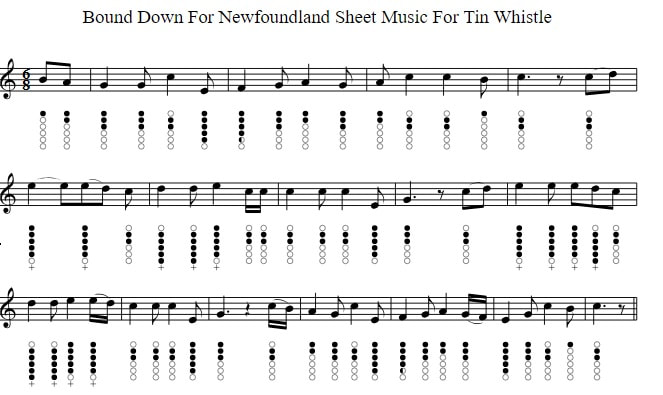
Bound Down For Newfoundland sheet music for tin whistle
​⚓ Bound Down for Newfoundland

Type: Traditional sea song / folk ballad
Origin: Atlantic Canada (Newfoundland and Labrador), with links to Ireland and Britain
Genre: Maritime folk / sea shanty
Themes: Sailing, hardship, farewells, and pride in seafaring life

🌊 Overview

“Bound Down for Newfoundland” (sometimes titled Bound Down for Newfoundland Town or We’re Bound Down for Newfoundland) is one of the most iconic North Atlantic sea songs, sung by sailors and fishermen traveling between Britain, Ireland, and Newfoundland during the 19th and early 20th centuries.

It’s both a work song and a narrative ballad, capturing the experience of men “bound down” — meaning sailing toward or down to — the harsh yet beloved shores of Newfoundland, an island that became a key destination for Atlantic fishing fleets and merchant vessels.

🛶 Historical Background

From the 1700s onward, ships regularly sailed between Ireland, England, and Newfoundland, transporting salt fish, timber, and other goods. Many Irish emigrants — especially from Waterford, Wexford, and Cork — went to Newfoundland seasonally or permanently for work in the cod fishing trade.

“Bound Down for Newfoundland” emerged from this shared seafaring heritage, with versions found in both Irish and Newfoundland songbooks.
It often served as a forebitter (a song sung off-duty, forward in the ship), rather than a hauling shanty.

The song vividly depicts the life of sailors as they leave port, face the perils of the sea, and look forward to returning to land — whether home or to Newfoundland itself, which many considered their second home.

🗣️ Lyrics (Typical Version)

We’re homeward bound this very day,
From fair old England’s shore,
We’ve left behind our sweethearts dear,
That we may see no more.

For we’re bound down for Newfoundland,
Our hearts are filled with joy,
For we’re going to see our own true love,
So lovely and so coy.

Other verses describe the journey across the Atlantic, the storms and gales, and the longing for home and love, mixing the hardship of the sailor’s life with a romantic ideal of courage and endurance.

🎵 Musical Characteristics

Time Signature: Typically 6/8 or 3/4 — a rolling rhythm that evokes the motion of the sea.

Mode: Often in D major or G major, but sung freely — as many traditional singers performed it unaccompanied.

Style: Ballad-like tempo; melodic and mournful yet proud.

Instrumentation (modern performances):

Guitar and mandolin accompaniment

Fiddle and accordion harmonies

Occasional bodhrán or low whistle for atmosphere

🎤 Notable Recordings

The Irish Rovers – recorded a lively and harmonized version in the 1960s, popularizing it internationally.

Ryan’s Fancy – gave it a warm, reflective tone in the 1970s, connecting it to Newfoundland identity.

Jim Payne and Fergus O’Byrne – presented traditional Newfoundland renditions.

Great Big Sea – sometimes referenced or reinterpreted the song in their maritime repertoire.

These performances helped cement Bound Down for Newfoundland as a symbol of Atlantic identity, bridging Irish and Canadian maritime traditions.

🧭 Cultural Meaning

This song carries dual emotional weight:

For Newfoundlanders, it’s an anthem of homecoming — a declaration of pride and love for the island.

For Irish people, it represents the emigration experience — the bittersweet departure from Ireland toward opportunity across the ocean.

The phrase “bound down” reflects not only the ship’s direction but also the sailor’s emotional state: bound to duty, to the sea, and to the uncertain promise of return.

📚 Key Themes
Theme Description
Sea life & hardship The dangers, storms, and endurance of sailors.
Love & longing Leaving loved ones behind — and the hope of reunion.
Emigration The emotional link between Ireland and Newfoundland.
Homecoming A joyful yet humble sense of belonging to the land and sea.
🪶 Legacy

“Bound Down for Newfoundland” remains a staple in Irish sessions, Newfoundland folk festivals, and maritime heritage events.
It’s often sung with pride, reflecting both the resilience of seafaring communities and the enduring bond between Ireland and Newfoundland — sometimes called “the most Irish place outside Ireland.”

The song endures because it tells a universal story:

leaving home, facing the unknown, and finding belonging across the sea.

🎼 Fun Fact

There’s an old Newfoundland saying inspired by songs like this:

“When the wind blows from the west, it’s time to sail for home — whether it’s Kinsale or St. John’s.”

It reminds us that for generations of Irish and Newfoundland sailors, home was always on both sides of the Atlantic.
Irish Sheet Music Ebook
PayPal Acceptance Mark
Picture
Blog
Privacy Policy
Cookie Consent
Copyright 2002 - 2025
Contact
  • Home
  • Lyrics And Chords
  • Tin Whistle Song Book
  • Tin Whistle