Baidin Fheilimi Irish song lyrics and chords
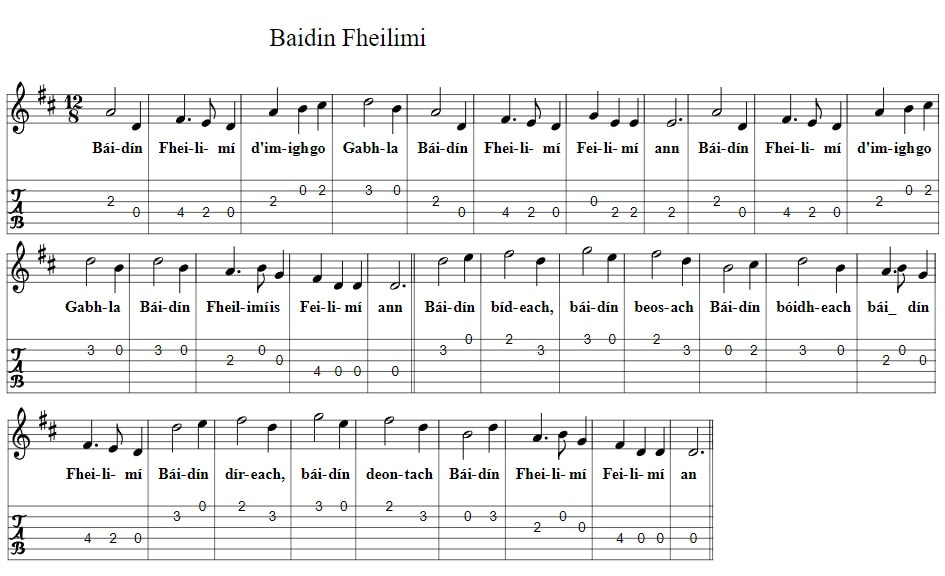
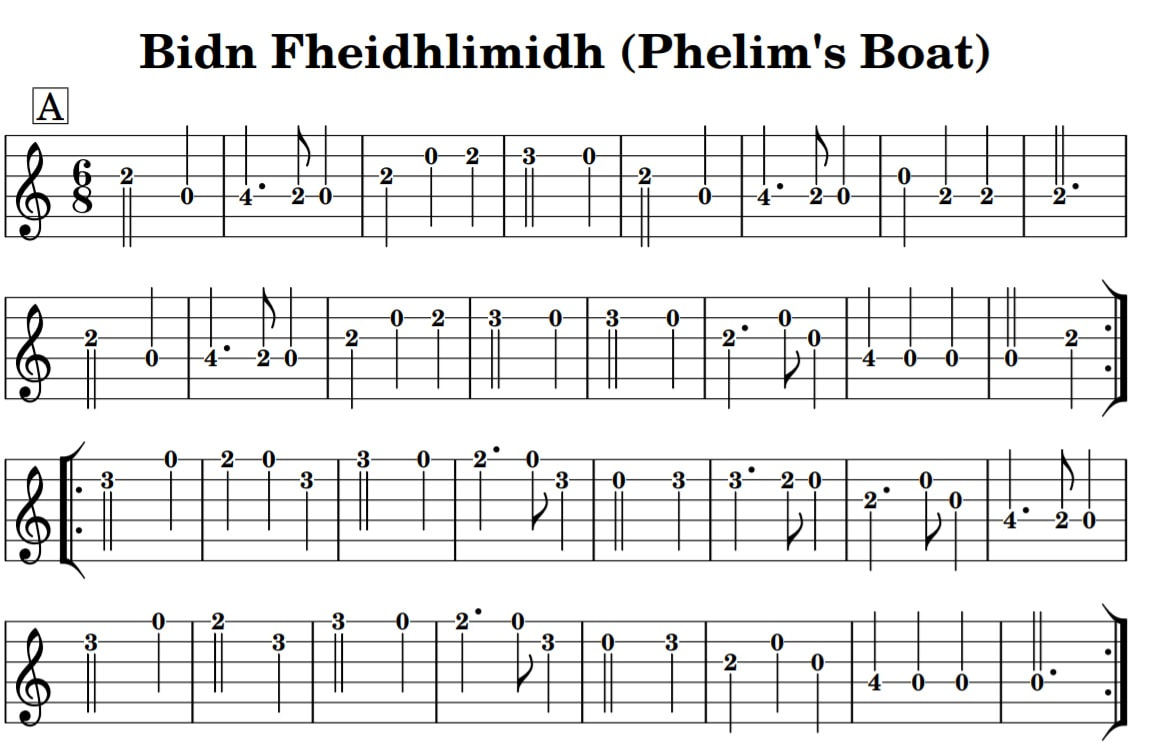
Báidín Fheilimidh guitar tab now added. A traditional song that was thought in schools in Ireland during the 1960s and 70s. Báidín Fheilimidh sheet music for tin whistle . The title of the song translate as ''Phelim's Little Boat'', Phelim was an Ulster chieftain who tried to escape his enemies in a small boat off the coast of Donegal Recorded by Na Casaidigh’s /The Cassidys and Sinéad O'Connors. As Gaeilge song lyrics . The guitar chords were worked out by Marc Fahrbach who comes from Germany, not bad for a German who had to put guitar chords to an Irish song for an Irishman. Stranger things have happened. Well done Marc. To play along with The Cassidys version place capo on the third fret.
Phelim’s Little Boat (English Translation)
Phelim’s little boat took off for Gola
Phelim’s little boat and Phelim in it
Phelim’s little boat took off for Gola
Phelim’s little boat and Phelim in it
Chorus:
A tiny little boat, a lively little boat
A foolish little boat, Phelim’s little boat
straight little boat, a willing little boat,
Phelim’s little boat and Phelim in it
Phelim’s little boat took off for Tory
Phelim’s little boat and Phelim in it
Phelim’s little boat took off for Tory
Phelim’s little boat and Phelim in it
Chorus
Phelim’s little boat was crushed against Tory
Phelim’s little boat and Phelim in it
Phelim’s little boat was crushed against Tory
Phelim’s little boat and Phelim in it
Alternative 3rd verse:
Phelim’s little boat was crushed against Tory
Fish on the table and Phelim with it
Phelim’s little boat was crushed against Tory
Fish on the table and Phelim with it
Phelim’s little boat took off for Gola
Phelim’s little boat and Phelim in it
Phelim’s little boat took off for Gola
Phelim’s little boat and Phelim in it
Chorus:
A tiny little boat, a lively little boat
A foolish little boat, Phelim’s little boat
straight little boat, a willing little boat,
Phelim’s little boat and Phelim in it
Phelim’s little boat took off for Tory
Phelim’s little boat and Phelim in it
Phelim’s little boat took off for Tory
Phelim’s little boat and Phelim in it
Chorus
Phelim’s little boat was crushed against Tory
Phelim’s little boat and Phelim in it
Phelim’s little boat was crushed against Tory
Phelim’s little boat and Phelim in it
Alternative 3rd verse:
Phelim’s little boat was crushed against Tory
Fish on the table and Phelim with it
Phelim’s little boat was crushed against Tory
Fish on the table and Phelim with it
Is amhrán beag álainn é seo faoi Phéilim ― fear nárbh fhada leis an cósta agus a raibh níos mó muiníne aige ina bhádín ná mar a bhí ag réaltaí pop ina ngairdín cúil. Tá bád beag Phéilim, cosúil le cónra adhmaid le seol, ag preabadh leis ar an bhfarraige, agus é ag ceapadh gur long cogaidh é.
“Bhádín bheag, spridbheag, amadán beag bródúil” ― sin é an chroílár!
Báidín ina leath-cheapadh, ach muinín Phéilim ina hiomlán.
Ar dtús, tá sé ag seoladh go Gabhla mar a bheadh rí na farraige ann – b’fhéidir le cuairt a thabhairt ar cháirde, nó b’fhéidir le bragáil faoi cé chomh maith is atá sé ag stiúradh rud nach bhfuil ach beagán níos mó ná ciúb mín-bháid.
Ansin go Toraí leis – agus sin iad na tonnta ag gáire:
“A Phéilim, a amadáin, níl do bhádín réidh don turas sin!”
Agus buail — briseann an bháidín i gcoinne na gcarraigeacha, mar a bheadh bainne ag bualadh le cloch. Ach ar a laghad, i leagan malartach an véarsa, bíonn iasc ar an mbord — mar a bheadh Pheilim ag rá:
“Níor fhill mé gan rud éigin a thabhairt abhaile!”
Agus é féin ag ithe iasc úr — cé go raibh ar an bhádín bás tapa a fháil.
Mar sin, is scéal é seo faoi fhear beag i mbád bheag ar fharraige mhór, a léiríonn spiorad na nGael: beag bídeach ó thaobh bealaigh de, ach mór ó thaobh croí agus misnigh de. Bhí an bháidín lúfar — agus Phéilim ina measc — ach níor réitigh an fharraige mórthimpeall leo.
Ach, ar ndóigh — bhí aoibhneas, ceol, agus spraoi sa scéal i gcónaí, mar is dual do na hÉireannaigh!
Translated to English.
Here is a translation of the text into English. It captures the humorous and affectionate tone of the original description of the song (which refers to the traditional Irish folk song, Báidín Fheidhlimidh).
This is a lovely little song about Phelim — a man who was never far from the coast and who had more confidence in his little boat than pop stars have in their back gardens. Phelim’s small boat, like a wooden coffin with a sail, is bouncing along on the sea, while he thinks it is a battleship.
"Little boat, spirited little thing, proud little fool" — that is the heart of it! A boat that was a half-baked notion, but Phelim’s confidence was absolute.
At first, he is sailing to Gola Island as if he were the king of the sea – maybe to visit friends, or maybe to brag about how well he is steering something that is only slightly bigger than a toy boat.
Then off to Tory Island he goes – and there are the waves laughing:
"Oh Phelim, you fool, your little boat isn't ready for that journey!"
And smack — the little boat crashes against the rocks, shattering like milk hitting a stone. But at least, in an alternative version of the verse, there is fish on the table — as if Phelim were saying:
"I didn't come back empty-handed!"
And there he is eating fresh fish — even though the little boat met a quick end.
So, this is a story about a little man in a little boat on a big sea, which portrays the spirit of the Gaels: tiny in terms of means, but huge in terms of heart and courage. The little boat was agile — and Phelim along with it — but the surrounding sea didn't agree with them.
But, of course — there was always joy, music, and fun in the story, as is the way of the Irish!
“Bhádín bheag, spridbheag, amadán beag bródúil” ― sin é an chroílár!
Báidín ina leath-cheapadh, ach muinín Phéilim ina hiomlán.
Ar dtús, tá sé ag seoladh go Gabhla mar a bheadh rí na farraige ann – b’fhéidir le cuairt a thabhairt ar cháirde, nó b’fhéidir le bragáil faoi cé chomh maith is atá sé ag stiúradh rud nach bhfuil ach beagán níos mó ná ciúb mín-bháid.
Ansin go Toraí leis – agus sin iad na tonnta ag gáire:
“A Phéilim, a amadáin, níl do bhádín réidh don turas sin!”
Agus buail — briseann an bháidín i gcoinne na gcarraigeacha, mar a bheadh bainne ag bualadh le cloch. Ach ar a laghad, i leagan malartach an véarsa, bíonn iasc ar an mbord — mar a bheadh Pheilim ag rá:
“Níor fhill mé gan rud éigin a thabhairt abhaile!”
Agus é féin ag ithe iasc úr — cé go raibh ar an bhádín bás tapa a fháil.
Mar sin, is scéal é seo faoi fhear beag i mbád bheag ar fharraige mhór, a léiríonn spiorad na nGael: beag bídeach ó thaobh bealaigh de, ach mór ó thaobh croí agus misnigh de. Bhí an bháidín lúfar — agus Phéilim ina measc — ach níor réitigh an fharraige mórthimpeall leo.
Ach, ar ndóigh — bhí aoibhneas, ceol, agus spraoi sa scéal i gcónaí, mar is dual do na hÉireannaigh!
Translated to English.
Here is a translation of the text into English. It captures the humorous and affectionate tone of the original description of the song (which refers to the traditional Irish folk song, Báidín Fheidhlimidh).
This is a lovely little song about Phelim — a man who was never far from the coast and who had more confidence in his little boat than pop stars have in their back gardens. Phelim’s small boat, like a wooden coffin with a sail, is bouncing along on the sea, while he thinks it is a battleship.
"Little boat, spirited little thing, proud little fool" — that is the heart of it! A boat that was a half-baked notion, but Phelim’s confidence was absolute.
At first, he is sailing to Gola Island as if he were the king of the sea – maybe to visit friends, or maybe to brag about how well he is steering something that is only slightly bigger than a toy boat.
Then off to Tory Island he goes – and there are the waves laughing:
"Oh Phelim, you fool, your little boat isn't ready for that journey!"
And smack — the little boat crashes against the rocks, shattering like milk hitting a stone. But at least, in an alternative version of the verse, there is fish on the table — as if Phelim were saying:
"I didn't come back empty-handed!"
And there he is eating fresh fish — even though the little boat met a quick end.
So, this is a story about a little man in a little boat on a big sea, which portrays the spirit of the Gaels: tiny in terms of means, but huge in terms of heart and courage. The little boat was agile — and Phelim along with it — but the surrounding sea didn't agree with them.
But, of course — there was always joy, music, and fun in the story, as is the way of the Irish!
Chords
(G)Báidín Fheilimidh d'imigh go (C)Gabhla,
(G)Báidín Fheilimidh ' s (Am)Feilimidh (D)ann,
(G)Báidín Fheilimidh d'imigh go (C)Gabhla
Báidín (D)Fheilimidh 's (G)Feilimidh ann.
Curfá:
(G)Báidín bídeach, (C)báidín (G)beosach,
(C)Báidín (Em)bóidheach, (D)báidín (G)Fheilimidh,
Báidín díreach, (C)báidín (G)déontach,
(C)Báidín (D)Fheilimidh 's (G)Feilimidh ann.
(G)Báidín Fheilimidh d ' imigh go (C)Toraigh,
(G)Báidín Fheilimidh 's (Am)Feilimidh (D)ann.
(G)Báidín Fheilimidh d ' imigh go (C)Toraigh,
Báidín (D)Fheilimidh 's (G)Feilimidh ann.
Curfá
(G)Báidín Fheilimidh briseadh i (C)dToraigh,
(G)Báidín Fheilimidh 's (Am)Feilimidh (D)ann.
(G)Báidín Fheilimidh briseadh i (C)dToraigh,
Báidín (D)Fheilimidh 's (G)Feilimidh ann.
An tríú véarsa eile:
(G)Báidín Fheilimidh briseadh i (C)dToraigh,
(G)Iasc ar bhord agus (Am)Feidhlimidh (D)ann.
(G)Báidín Fheilimidh briseadh i (C)dToraigh,
Iasc ar (D)bhord agus (G)Fheidhlimidh ann.
Curfá
Instrumental outro in F major:
F F F Bb
F F Gm C
F F F Bb
Bb C F
F F Bb F
Bb Dm C F
F F Bb F
Bb C F
(G)Báidín Fheilimidh d'imigh go (C)Gabhla,
(G)Báidín Fheilimidh ' s (Am)Feilimidh (D)ann,
(G)Báidín Fheilimidh d'imigh go (C)Gabhla
Báidín (D)Fheilimidh 's (G)Feilimidh ann.
Curfá:
(G)Báidín bídeach, (C)báidín (G)beosach,
(C)Báidín (Em)bóidheach, (D)báidín (G)Fheilimidh,
Báidín díreach, (C)báidín (G)déontach,
(C)Báidín (D)Fheilimidh 's (G)Feilimidh ann.
(G)Báidín Fheilimidh d ' imigh go (C)Toraigh,
(G)Báidín Fheilimidh 's (Am)Feilimidh (D)ann.
(G)Báidín Fheilimidh d ' imigh go (C)Toraigh,
Báidín (D)Fheilimidh 's (G)Feilimidh ann.
Curfá
(G)Báidín Fheilimidh briseadh i (C)dToraigh,
(G)Báidín Fheilimidh 's (Am)Feilimidh (D)ann.
(G)Báidín Fheilimidh briseadh i (C)dToraigh,
Báidín (D)Fheilimidh 's (G)Feilimidh ann.
An tríú véarsa eile:
(G)Báidín Fheilimidh briseadh i (C)dToraigh,
(G)Iasc ar bhord agus (Am)Feidhlimidh (D)ann.
(G)Báidín Fheilimidh briseadh i (C)dToraigh,
Iasc ar (D)bhord agus (G)Fheidhlimidh ann.
Curfá
Instrumental outro in F major:
F F F Bb
F F Gm C
F F F Bb
Bb C F
F F Bb F
Bb Dm C F
F F Bb F
Bb C F
It’s usually sung in a bright 2/4 or 4/4 rhythm, depending on the region —
we’ll go with 2/4 to keep that classic Irish boat-song bounce.
Below you’ll find:
A strumming pattern that matches the traditional rhythm.
A fingerpicking tab for the first verse — easy to play, rhythmic, and true to the song’s feel.
🎸 Strumming Pattern (2/4 Jig-like Folk Pulse)
Think of the rhythm as a light rowing motion — steady but bouncy.
Count: 1 2 (strong–soft)
Pattern:
↓ (bass) ↓↑
(count: 1 & 2 &)
Beat 1 → Downstroke on the bass note (for pulse)
Beat 2 → Light down-up across treble strings
It gives a nice boom–chick feel, perfect for Irish folk.
Example (G chord):
| G | G |
↓ ↓↑
1 & 2 &
Bass alternation ideas:
G → alternate 6th and 4th strings
C → alternate 5th and 4th strings
D → alternate 4th and 5th strings
Am → alternate 5th and 6th strings
Em → alternate 6th and 4th strings
🎵 Fingerpicking Tab (First Verse)
We’ll use a steady alternating bass pattern to imitate that “rowing” rhythm.
Each measure has bass → treble → bass → treble, fitting the 2/4 feel.
Use:
Thumb (p) – bass strings (E, A, or D)
Index (i) – G string
Middle (m) – B string
First Verse Tab
G C G
e|--------3-----------3----------|--------0-------------0----------|--------3-----------3----------|
B|------0---0-------0---0--------|------1---1---------1---1--------|------0---0-------0---0--------|
G|----0-------0---0-------0------|----0-------0-----0-------0------|----0-------0---0-------0------|
D|--0-----------0----------------|--2-----------2------------------|--0-----------0----------------|
A|-------------------------------|3-------------------------------2|-------------------------------|
E|-3-----------3-----------------|---------------------------------|3-----------3------------------|
Báidín Fheilimidh d’imigh go Gabhla, Báidín Fheilimidh 's Feilimidh ann,
G C G Am D
e|--------3-----------3--------|--------0-------------0------|--------3-----------3------|--------0-----------2------|
B|------0---0-------0---0------|------1---1---------1---1----|------0---0-------0---0----|------1---1-------3---3----|
G|----0-------0---0-------0----|----0-------0-----0-------0--|----0-------0---0-------0--|----2-------2---2-------2--|
D|--0-----------0--------------|--2-----------2---------------|--0-----------0------------|--0-----------0------------|
A|------------------------------|3-----------------------------|---------------------------|0---------------------------|
E|-3-----------3----------------|------------------------------|-3-----------3-------------|-----------------------------|
Báidín Fheilimidh d’imigh go Gabhla, Báidín Fheilimidh 's Feilimidh ann.
🎶 Performance Tips
Keep your thumb steady — this drives the rhythm like oars in the water.
Light touch on treble strings — let the melody float above the pulse.
Slight accent on beat 1 gives that traditional “rowing” motion.
You can hum or lightly whistle the melody between verses for effect.
we’ll go with 2/4 to keep that classic Irish boat-song bounce.
Below you’ll find:
A strumming pattern that matches the traditional rhythm.
A fingerpicking tab for the first verse — easy to play, rhythmic, and true to the song’s feel.
🎸 Strumming Pattern (2/4 Jig-like Folk Pulse)
Think of the rhythm as a light rowing motion — steady but bouncy.
Count: 1 2 (strong–soft)
Pattern:
↓ (bass) ↓↑
(count: 1 & 2 &)
Beat 1 → Downstroke on the bass note (for pulse)
Beat 2 → Light down-up across treble strings
It gives a nice boom–chick feel, perfect for Irish folk.
Example (G chord):
| G | G |
↓ ↓↑
1 & 2 &
Bass alternation ideas:
G → alternate 6th and 4th strings
C → alternate 5th and 4th strings
D → alternate 4th and 5th strings
Am → alternate 5th and 6th strings
Em → alternate 6th and 4th strings
🎵 Fingerpicking Tab (First Verse)
We’ll use a steady alternating bass pattern to imitate that “rowing” rhythm.
Each measure has bass → treble → bass → treble, fitting the 2/4 feel.
Use:
Thumb (p) – bass strings (E, A, or D)
Index (i) – G string
Middle (m) – B string
First Verse Tab
G C G
e|--------3-----------3----------|--------0-------------0----------|--------3-----------3----------|
B|------0---0-------0---0--------|------1---1---------1---1--------|------0---0-------0---0--------|
G|----0-------0---0-------0------|----0-------0-----0-------0------|----0-------0---0-------0------|
D|--0-----------0----------------|--2-----------2------------------|--0-----------0----------------|
A|-------------------------------|3-------------------------------2|-------------------------------|
E|-3-----------3-----------------|---------------------------------|3-----------3------------------|
Báidín Fheilimidh d’imigh go Gabhla, Báidín Fheilimidh 's Feilimidh ann,
G C G Am D
e|--------3-----------3--------|--------0-------------0------|--------3-----------3------|--------0-----------2------|
B|------0---0-------0---0------|------1---1---------1---1----|------0---0-------0---0----|------1---1-------3---3----|
G|----0-------0---0-------0----|----0-------0-----0-------0--|----0-------0---0-------0--|----2-------2---2-------2--|
D|--0-----------0--------------|--2-----------2---------------|--0-----------0------------|--0-----------0------------|
A|------------------------------|3-----------------------------|---------------------------|0---------------------------|
E|-3-----------3----------------|------------------------------|-3-----------3-------------|-----------------------------|
Báidín Fheilimidh d’imigh go Gabhla, Báidín Fheilimidh 's Feilimidh ann.
🎶 Performance Tips
Keep your thumb steady — this drives the rhythm like oars in the water.
Light touch on treble strings — let the melody float above the pulse.
Slight accent on beat 1 gives that traditional “rowing” motion.
You can hum or lightly whistle the melody between verses for effect.