You Seldom Come To See Me Anymore lyrics and chords
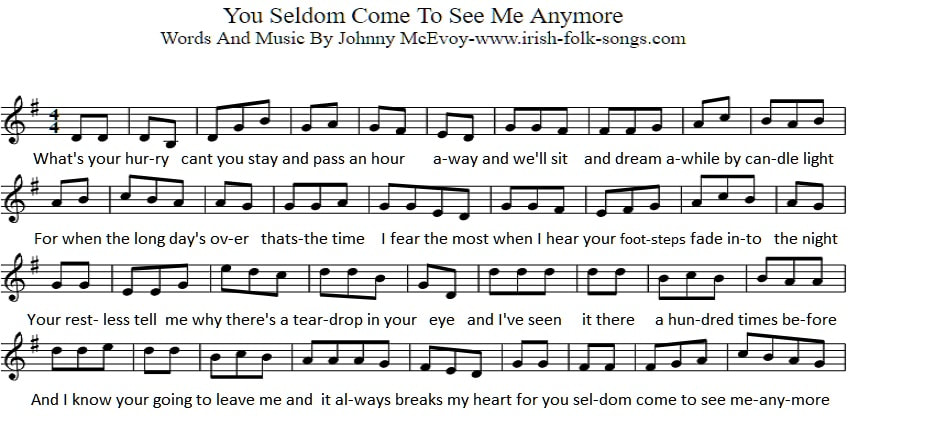
Johnny McEvoy lyrics and guitar chords. thanks again to Marc Fahrbach for working out the chords.brilliant song and a favorite of mine. Also recorded by Susan McCann, Paddy O'Brien, Hugo Duncan. The sheet music notes are included. Return to the songs of Johnny McEvoy which include the lyrics and chords of his best known songs.You seldom come to see me anymore piano sheet music with chords link is below.
[G]What's your hurry can't you stay and[Am] pass an [C]hour a[G]way
And[D] we'll sit and dream a [D7]while by cand[G]lelight[D7]
[G]For when the long days over that's the [C]time I fear the[G] most
When I [D]hear your footsteps[D7] fade into the[G] night
Chorus
You're[C] restless tell me[C7] why there's a[G] teardrop in you're eye
And I've seen it there a[Am7] hundred[G] times be[D]fore
And I [G]know you're going to[G7] leave me and it [C]always[D7] breaks my[G] heart
For you[D] seldom come to[D7] see me any[G] more
I well recalled that day when my ship it sailed away
To a far off distant land across the sea
Where a cruel war was raging where time was standing still
And blind hatred was the order of the day
Chorus
I know it can't be said for a soldier's wife to hear
How he helped to keep his country proud and free
No ------ or fancy ribbons can ever ease the pain
When he comes back half the man he used to be
And[D] we'll sit and dream a [D7]while by cand[G]lelight[D7]
[G]For when the long days over that's the [C]time I fear the[G] most
When I [D]hear your footsteps[D7] fade into the[G] night
Chorus
You're[C] restless tell me[C7] why there's a[G] teardrop in you're eye
And I've seen it there a[Am7] hundred[G] times be[D]fore
And I [G]know you're going to[G7] leave me and it [C]always[D7] breaks my[G] heart
For you[D] seldom come to[D7] see me any[G] more
I well recalled that day when my ship it sailed away
To a far off distant land across the sea
Where a cruel war was raging where time was standing still
And blind hatred was the order of the day
Chorus
I know it can't be said for a soldier's wife to hear
How he helped to keep his country proud and free
No ------ or fancy ribbons can ever ease the pain
When he comes back half the man he used to be
Guitar chords in the key of D Major.
[D]What's your hurry can't you stay and[Em] pass an [G]hour a[D]way
And[A] we'll sit and dream a [A7]while by cand[D]lelight[A7]
[D]For when the long days over that's the [G]time I fear the[D] most
When I [A]hear your footsteps[A7] fade into the[D] night
Chorus
You're[G] restless tell me[G7] why there's a[D] teardrop in you're eye
And I've seen it there a[Em7] hundred[D] times be[A]fore
And I [D]know you're going to[D7] leave me and it [G]always[A7] breaks my[D] heart
For you[A] seldom come to[A7] see me any[D] more
[D]What's your hurry can't you stay and[Em] pass an [G]hour a[D]way
And[A] we'll sit and dream a [A7]while by cand[D]lelight[A7]
[D]For when the long days over that's the [G]time I fear the[D] most
When I [A]hear your footsteps[A7] fade into the[D] night
Chorus
You're[G] restless tell me[G7] why there's a[D] teardrop in you're eye
And I've seen it there a[Em7] hundred[D] times be[A]fore
And I [D]know you're going to[D7] leave me and it [G]always[A7] breaks my[D] heart
For you[A] seldom come to[A7] see me any[D] more
The above list of sheet music / tin whistle notes are in
The Johnny McEvoy ebook of songs at the bottom of this page.
The Opening Stanza (From the Wife's Perspective): The song begins with a direct plea from a woman to her partner. The lines "What's your hurry can't you stay and pass an hour away" and "I hear your footsteps fade into the night" immediately set a tone of longing and sadness. She's desperate for him to stay, to connect, but she senses his withdrawal. The candlelight creates an intimate but fragile atmosphere. This stanza establishes a feeling of loneliness and impending separation, hinting at a distance between them that is more than just physical.
The Chorus (From the Wife's Perspective): The chorus is the heart of the song's emotional core. "You're restless tell me why there's a teardrop in your eye" points to the deep emotional trauma her partner is carrying. The repetition of "a hundred times before" and the line "you seldom come to see me any more" reveals that this is a long-standing issue, not a one-time event. She knows he's going to leave again, and it "always breaks my heart." This chorus perfectly captures the cycle of hope and disappointment she endures, as he is emotionally and perhaps physically distant, even when he is with her.
The Final Stanza (Shared/Narrator's Perspective): The last verse is a powerful and heartbreaking commentary on the consequences of war. It's almost a universal truth. The line "I know it can't be said for a soldier's wife to hear / How he helped to keep his country proud and free" is deeply ironic. The official narrative of a soldier's valor ("proud and free") stands in stark contrast to the grim reality. The line "No medals or fancy ribbons can ever ease the pain / When he comes back half the man he used to be" is the song's devastating climax. It shatters any romanticized notion of military service. The "half the man he used to be" can refer to physical injuries, but more likely refers to the psychological damage, the loss of his former self, his peace of mind, and his ability to connect with loved ones.
The Chorus (From the Wife's Perspective): The chorus is the heart of the song's emotional core. "You're restless tell me why there's a teardrop in your eye" points to the deep emotional trauma her partner is carrying. The repetition of "a hundred times before" and the line "you seldom come to see me any more" reveals that this is a long-standing issue, not a one-time event. She knows he's going to leave again, and it "always breaks my heart." This chorus perfectly captures the cycle of hope and disappointment she endures, as he is emotionally and perhaps physically distant, even when he is with her.
The Final Stanza (Shared/Narrator's Perspective): The last verse is a powerful and heartbreaking commentary on the consequences of war. It's almost a universal truth. The line "I know it can't be said for a soldier's wife to hear / How he helped to keep his country proud and free" is deeply ironic. The official narrative of a soldier's valor ("proud and free") stands in stark contrast to the grim reality. The line "No medals or fancy ribbons can ever ease the pain / When he comes back half the man he used to be" is the song's devastating climax. It shatters any romanticized notion of military service. The "half the man he used to be" can refer to physical injuries, but more likely refers to the psychological damage, the loss of his former self, his peace of mind, and his ability to connect with loved ones.