The Wild Colonial Boy Lyrics, Chords And Sheet Music
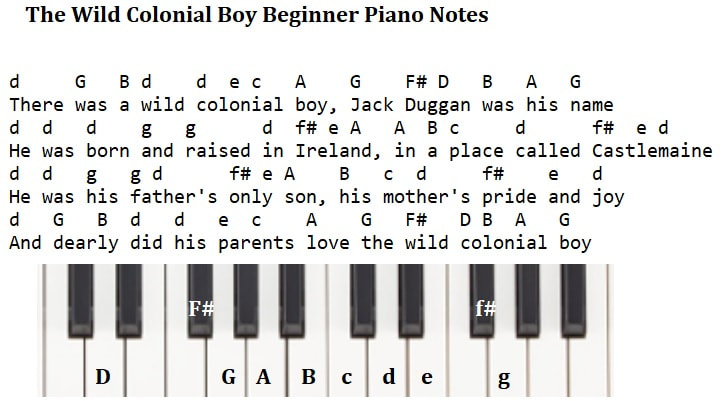
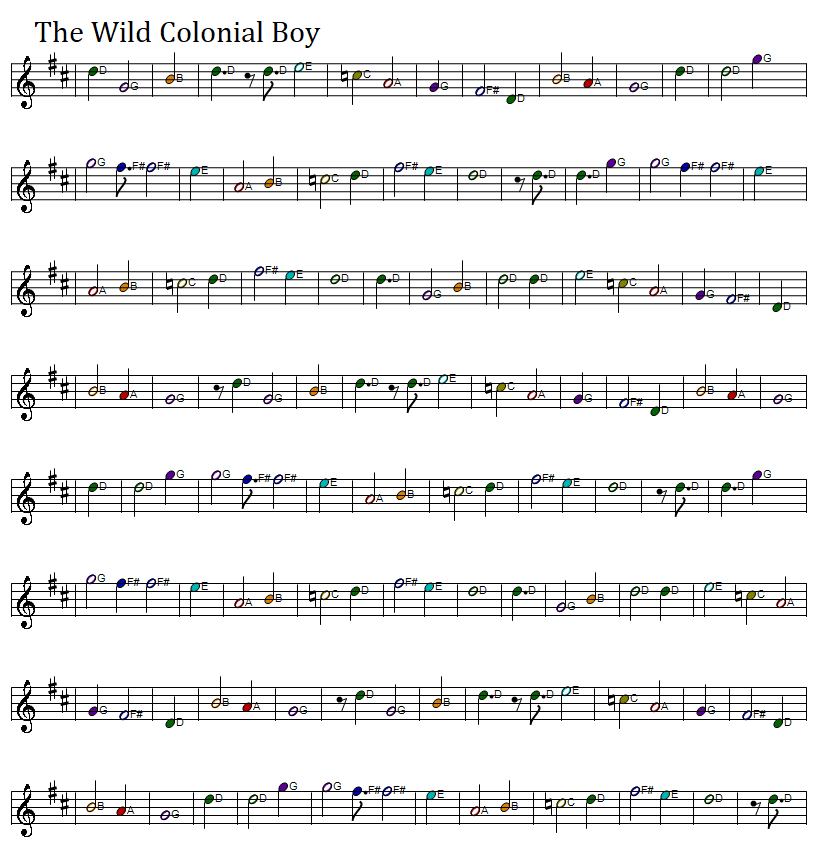
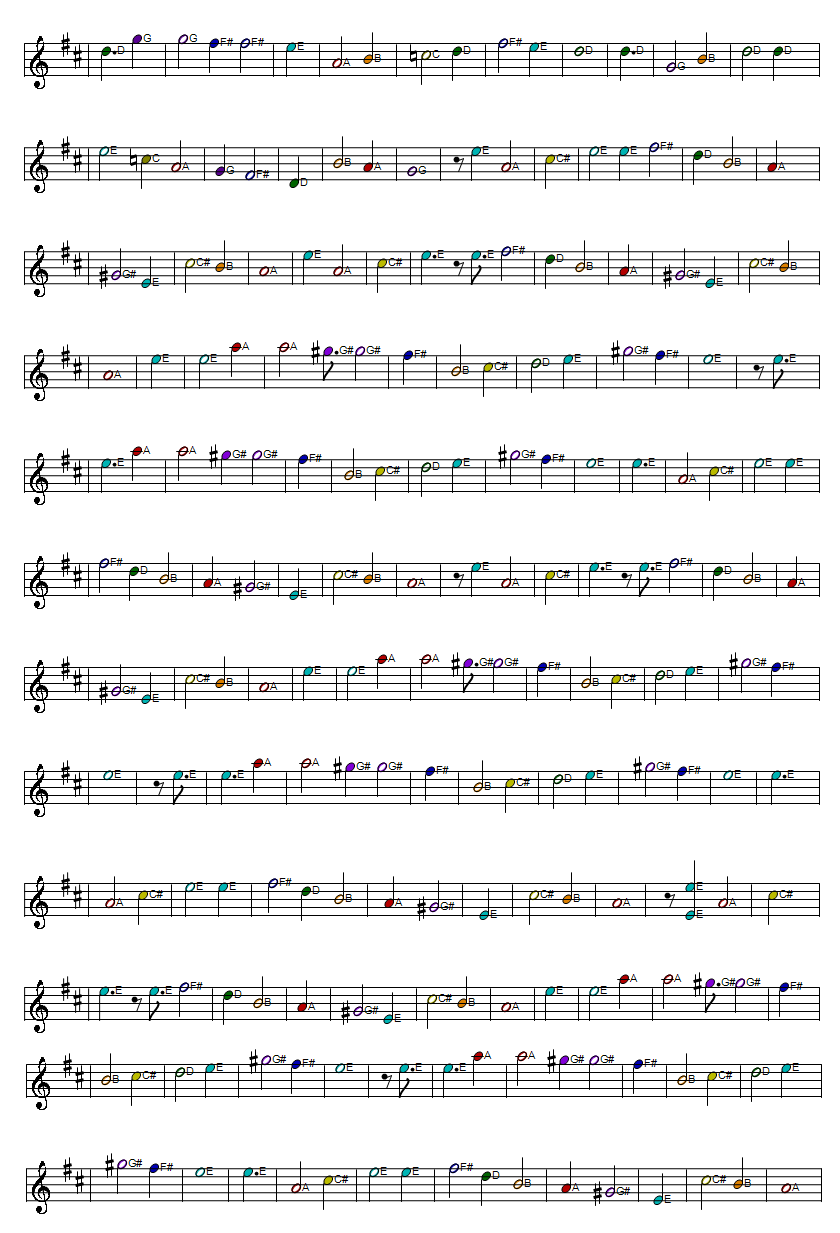
The full sheet music piano score with letter notes is included in the key of D Major. The 5 string banjo chords are included.Recorded by The Clancy Brothers And Tommy Makem- Written by Francis McNamara, The Irish version is the one I have put chords to. The sheet music and tin whistle notes are included. Guitar chords are in chordpro. There are at least thirty six versions that I have come across while researching this song. Also recorded by Dr. Hook, The Irish Rovers [ lyrics ] and Mick Jagger from The Rolling Stones. The song featured in the movie The Quiet Man by John Ford. Another popular song that was in The Quiet Man is Mush Mush [ lyrics ] which was sang by the actor Barry Fitzgerald. It was sang in the pub about 10 minutes into the film with a man playing the accordion. Also recorded by Robbie O'Connell. The wild colonial boy easy beginner piano notes now included.
|
[C]There was a Wild Col[F]onial[G7] Boy,
Jack Duggan was his[C] name, He was born and reared in[G] Ireland, In a[G7] place called Castle[C]maine, He was his father's[G] only son, And his[G7] mother's pride and[C] joy, And dearly[C7] did his[F] parents[G] love The Wild Co[G]lonial[C] Boy. At hammer throwing Jack was great, Or swinging a caman, He led the boys in all their pranks From dusk to early dawn. At fishin' or at poachin' trout, He was the real McCoy, And all the neighbours loved young Jack, The Wild Colonial Boy. At the early age of sixteen years, He left his native home; And to Australia's sunny land He was inclined to roam. He robbed the rich, and he helped the poor He stabbed James MacEvoy. A terror to Australia was The Wild Colonial Boy. For two more years this daring youth Ran on his wild career, With a head that knew no danger And a heart that knew no fear. He robbed outright the wealthy squires, And their arms he did destroy; And woe to all who dared to fight The Wild Colonial Boy. He loved the Prairie and the Bush, Where Rangers rode along; With his gun stuck in its holster deep, He sang a merry song. But if a foe once crossed his track, And sought him to destroy He'd get sharp shootin' sure from Jack, The Wild Colonial Boy. One morning on the prairie wild, Jack Duggan rode along, While listening to the mocking bird Singing a cheerful song, Out jumped three troopers, fierce and grim, Kelly, Davis and Fitzroy: They all set out to capture him, The Wild Colonial boy. "Surrender now, Jack Duggan, Come: "You see there's three to one! Surrender in the Queen's name, Sir, You are a plundering son!" Jack drew two pistols from his side, And glared upon Fitzroy; "I'll fight, but not surrender!" cried The Wild Colonial Boy. He fired a shot at Kelly Which brought him to the ground, He fired point blank at Davis, too Who fell dead at the sound, But a bullet pierced his brave young heart From the pistol of Fitzroy; And that was how they captured him, The Wild Colonial Boy. Below is a complete fingerpicking guitar tab for one verse, using a simple, traditional folk arpeggio pattern that matches the rhythm and feel of the song. 🎸 Fingerpicking Style Time signature: 4/4 (steady, storytelling tempo) Pattern: Thumb (p) – Bass note → Index (i) – G string → Middle (m) – B string → Ring (a) – high E string Keep it flowing like: Bass – G – B – E For longer measures, repeat the pattern or alternate bass notes. 🎵 Fingerpicking Guitar Tab (Verse 1: “There was a Wild Colonial Boy…”) [ C ] e|--------0-----------0-------------0-----------0-----------| B|------1---1-------1---1---------1---1-------1---1---------| G|----0-------0---0-------0-----0-------0---0-------0-------| D|--2-----------2-------------------------------------------| A|3-----------------3---------------------------------------| E|----------------------------------------------------------| [ F ] e|--------1-----------1-------------1-----------1-----------| B|------1---1-------1---1---------1---1-------1---1---------| G|----2-------2---2-------2-----2-------2---2-------2-------| D|--3-----------3-------------------------------------------| A|----------------------3-----------3-----------------------| E|1---------------------------------------------------------| [ G7 ] e|--------1-----------1-------------1-----------1-----------| B|------0---0-------0---0---------0---0-------0---0---------| G|----0-------0---0-------0-----0-------0---0-------0-------| D|----------------------0-----------0-----------------------| A|------------------2---------------------------------------| E|3---------------------------------------------------------| Now, follow the chord progression from your verse: 🎶 Full Verse (Fingerpicking Order) [C] There was a Wild Col[F]onial [G7]Boy, [C] Jack Duggan was his [G7]name, He [C]was born and reared in [G]Ireland, In a [G7]place called Castle[C]maine, He [C]was his father’s [G]only son, And his [G7]mother’s pride and [C]joy, And [C7]dearly did his [F]parents [G7]love The Wild Co[G]lonial [C]Boy. 🎵 Suggested Flow Between Chords Line Pattern Suggestion “There was a Wild Colonial Boy” Pick C → F → G7 (one bar each) “Jack Duggan was his name” C → G7 “He was born and reared in Ireland” C → G → G7 → C “He was his father’s only son…” C → G → G7 → C → C7 → F → G7 → G → C 💡 Playing Tips Keep your thumb steady on the bass (A for C, E for G, low E or A for F). Let notes ring into one another for that open Irish feel. Add soft hammer-ons (like 0h2 on D string in the C chord) occasionally to give it some movement. If playing with a singer, slow the tempo slightly and emphasize the bass beat on beats 1 and 3. 🎵 “The Wild Colonial Boy” — where the melody is played on the treble strings while the bass and chords are fingerpicked underneath.
This version is in C Major, perfectly singable and warm on the guitar. 🎸 Tuning & Tempo Standard tuning (EADGBE) Tempo: ~80 BPM, gentle storytelling pace Style: Folk ballad (Thumb on bass; fingers pluck melody and harmony) 🎶 Fingerstyle Arrangement — Verse 1 “There was a Wild Colonial Boy, Jack Duggan was his name…” [ C ] e|--------------------0----------------------0---------------| B|---------1---1-3-------1---1-3-1---0---1-------------------| G|-----0--------------------0----------------0---------------| D|--2----------------------2----------------2----------------| A|3----------------------------------------------------------| E|-----------------------------------------------------------| "There was a Wild Colonial Boy" [ F ] e|-------------1-0--------------1-----------------------------| B|-------1-3--------1----1-3-1------1-------------------------| G|-----2---------------2-------------2------------------------| D|--3--------------------------------------------------------| A|------------------3-------------------3---------------------| E|1----------------------------------------------------------| [ G7 ] e|------------------1-------------1---------------------------| B|----------0-1-0-----0------0-1------0-----------------------| G|------0------------------0-------------0--------------------| D|-----------------0------------------------------------------| A|---------------2--------------------------------------------| E|--3---------------------------------------------------------| "Jack Duggan was his name" [ C ] e|-------------0----------------------0-----------------------| B|-------1-3-------1------------------1-----------------------| G|-----0-------------0---0------------0-----------------------| D|--2------------------2--------------2-----------------------| A|3----------------------------------3------------------------| E|------------------------------------------------------------| 🎵 Continuing the Verse “He was born and reared in Ireland, in a place called Castlemaine…” [ G ] e|----------------------3-------------3-----------------------| B|----------0-1-0---------0------0-1------0-------------------| G|------0---------0---0---------0-------------0---------------| D|-----------------0------------------------------------------| A|---------------2--------------------------------------------| E|--3---------------------------------------------------------| [ G7 ] e|-------------1-----------------------1----------------------| B|-------0-1-0----0-------------0-1-0----0--------------------| G|-----0-------------0---------0-------------0----------------| D|-----------------0------------------------------------------| A|---------------2--------------------------------------------| E|--3---------------------------------------------------------| [ C ] e|------------0----------------------0------------------------| B|------1-3-------1-----------1-3-------1---------------------| G|----0-------------0-------0-------------0-------------------| D|--2----------------2---2----------------2-------------------| A|3----------------------------------------------------------| E|------------------------------------------------------------| 🎵 Final Lines “And dearly did his parents love the Wild Colonial Boy.” [ C7 ] e|------------0---------------------0-------------------------| B|------1-3-------1----------------1--------------------------| G|----3-------------3---3----------3--------------------------| D|--2------------------2-----------2--------------------------| A|3-----------------------------------------------------------| E|------------------------------------------------------------| [ F ] e|------------1-----------------------1-----------------------| B|------1-3-------1-----------1-3-------1---------------------| G|----2-------------2-------2-------------2-------------------| D|--3----------------3---3----------------3-------------------| A|------------------------------------------------------------| E|1-----------------------------------------------------------| [ G7 ] e|-------------1----------------------------------------------| B|-------0-1-0----0-------------------------------------------| G|-----0-------------0----------------------------------------| D|-----------------0------------------------------------------| A|---------------2--------------------------------------------| E|--3---------------------------------------------------------| [ C ] e|-------------0----------------------------------------------| B|-------1-3-------1------------------------------------------| G|-----0-------------0----------------------------------------| D|--2-----------------2---------------------------------------| A|3-----------------------------------------------------------| E|------------------------------------------------------------| 💡 Playing Tips Thumb (p) = bass notes (E, A, D) Index (i) = G string Middle (m) = B string Ring (a) = high E string Let the melody notes (on top strings) ring clearly — they carry the vocal line. Play slowly, like a storyteller. Think of the rhythm of the lyrics to guide the phrasing. 🎵 Optional Ending (Soft Tag) Finish the verse with: [C] e|--------0-------------0------------------------------------| B|------1---1---------1---1----------------------------------| G|----0-------0-----0-------0--------------------------------| D|--2-----------2-2------------------------------------------| A|3----------------------------------------------------------| E|-----------------------------------------------------------| Let it ring — the open, pure C chord closes the verse beautifully. Guitar chords for all verses.
(Traditional – Key: C Major) [Verse 1] [C]There was a Wild Col[F]onial [G7]Boy, Jack Duggan was his [C]name, He was born and reared in [G]Ireland, In a [G7]place called Castle[C]maine. He was his father's [G]only son, And his [G7]mother's pride and [C]joy, And dearly [C7]did his [F]parents [G]love The Wild Co[G7]lonial [C]Boy. [Verse 2] At [C]hammer throwing Jack was [F]great, Or [G7]swinging a cama[C]n, He led the boys in all their [G]pranks From [G7]dusk till early [C]dawn. At fishin’ or at [G]poachin’ trout, He was the [G7]real Mc[C]Coy, And all the [C7]neighbours [F]loved young [G]Jack, The Wild Co[G7]lonial [C]Boy. [Verse 3] At the [C]early age of sixteen [F]years, He [G7]left his native [C]home; And to Australia’s sunny [G]land, He was [G7]inclined to [C]roam. He robbed the rich and [G]helped the poor, He stabbed James [G7]MacE[C]voy, A terror to [C7]Australia [F]was, The Wild Co[G7]lonial [C]Boy. [Verse 4] For [C]two more years this daring [F]youth Ran [G7]on his wild ca[C]reer, With a head that knew no [G]danger And a [G7]heart that knew no [C]fear. He robbed outright the [G]wealthy squires, And their [G7]arms he did de[C]stroy, And woe to [C7]all who [F]dared to [G]fight The Wild Co[G7]lonial [C]Boy. [Verse 5] He [C]loved the prairie and the [F]bush, Where [G7]rangers rode a[C]long; With his gun stuck in its [G]holster deep, He [G7]sang a merry [C]song. But if a foe once [G]crossed his track And [G7]sought him to de[C]stroy, He’d get sharp [C7]shootin’ [F]sure from [G]Jack, The Wild Co[G7]lonial [C]Boy. [Verse 6] One [C]morning on the prairie [F]wild, Jack [G7]Duggan rode a[C]long, While listening to the [G]mocking bird Sing [G7]out its cheerful [C]song. Out jumped three troopers, [G]fierce and grim, Kelly, [G7]Davis and Fitz[C]roy -- They all set [C7]out to [F]capture [G]him, The Wild Co[G7]lonial [C]Boy. [Verse 7] “Sur[C]render now, Jack Duggan, [F]come, You [G7]see there’s three to [C]one! Surrender in the Queen’s own [G]name, You [G7]plundering son of a [C]gun!” Jack drew two pistols [G]from his side, And [G7]glared upon Fitz[C]roy: “I’ll fight, but [C7]not sur[F]ren[G]der!” cried The Wild Co[G7]lonial [C]Boy. [Verse 8] He [C]fired a shot at [F]Kelly, Which [G7]brought him to the [C]ground, He fired point blank at [G]Davis, too, Who [G7]fell dead at the [C]sound. But a bullet pierced his [G]brave young heart, From the [G7]pistol of Fitz[C]roy -- And that was [C7]how they [F]captured [G]him, The Wild Co[G7]lonial [C]Boy. 🎸 Guitar Notes:
Key of G guitar chords
[G]There was a Wild Col[C]onial[D7] Boy, Jack Duggan was his[G] name, He was born and reared in[D] Ireland, In a[D7] place called Castle[G]maine, He was his father's[D] only son, And his[D7] mother's pride and[G] joy, And dearly[G7] did his[C] parents[D] love The Wild Co[D]lonial[G] Boy. Key of D chords [D]There was a Wild Col[G]onial[A7] Boy, Jack Duggan was his[D] name, He was born and reared in[A] Ireland, In a[A7] place called Castle[D]maine, He was his father's[A] only son, And his[A7] mother's pride and[D] joy, And dearly[D7] did his[G] parents[A] love The Wild Co[A]lonial[D] Boy. Ellis/Timms version
There was a wild colonial boy, Jack Donahoe by name, Of poor but honest parents he was born in Castlemaine. He was his father's dearest hope, his mother's pride and joy, O, fondly did his parents love the wild colonial boy. Chorus: Then come away my hearties, we'll roam the hills so high, Together we will plunder, together we will die. We'll cross the wild Blue Mountains, and scour the Bathurst Plains, For we scorn to live in slavery, bound down with iron chains. He was scarcely sixteen years of age when he left his father's home, A convict to Australia, across the seas to roam, They put him in the iron gang in the Government employ, But never an iron on earth could hold the wild colonial boy. And when they sentenced him to hang to end his wild career, With a loud shout of defiance, bold Donahoe broke clear. He robbed the wealthy silvertails, their stock he did destroy, But no trooper in the land could catch the wild colonial boy. Then one day when he was cruising near the broad Nepean's side, From out the thick Bringelly bush the horse police did ride. "Die or resign, Jack Donahoe" they shouted in their joy, "I'll fight this night with all my might!" cried the wild colonial boy.!" Thus he fought six rounds with the horse police before the fatal ball, Which pierced his heart and made him start, caused Donahoe to fall, And then he closed his mournful eyes, his pistol an empty toy, Crying, "Parents dear, O say a prayer for the wild colonial boy." Below is the list of sheet music and tin whistle songs that are in my ebooks. This is the largest collection of tin whistle songs ever put together.[over 900 songs ] Including folk, pop and trad tunes plus German And French songs along with Christmas Carols.
All of the sheet music tabs have been made as easy to play as was possible. The price of the ebooks is €7.50 |
|
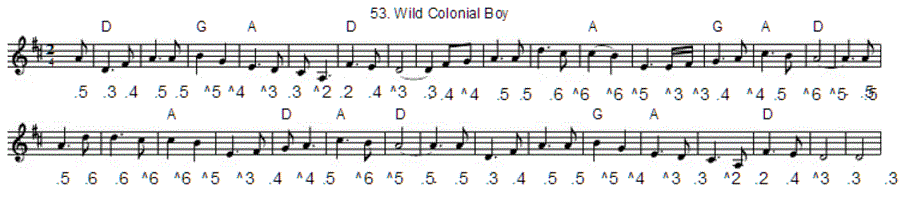
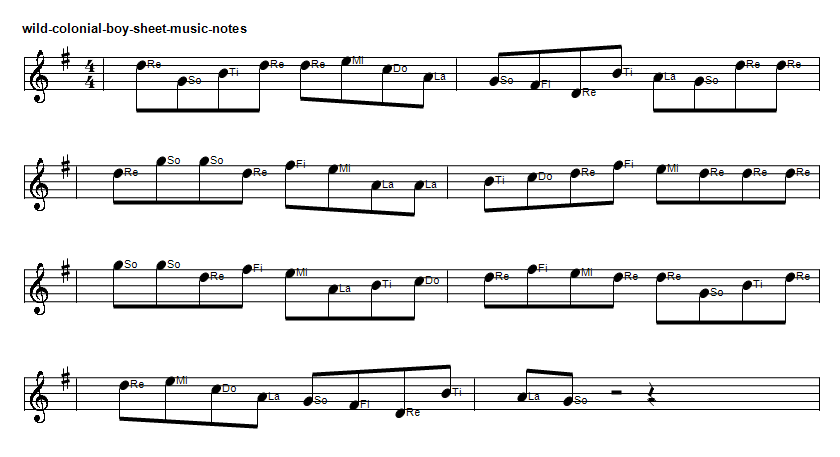
Wild colonial boy piano sheet music notes in solfege , do re mi format.
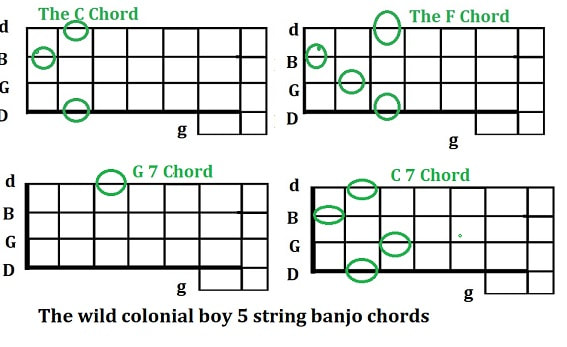
The Wild Colonial Boy 5 string banjo chords for the key of C Major.
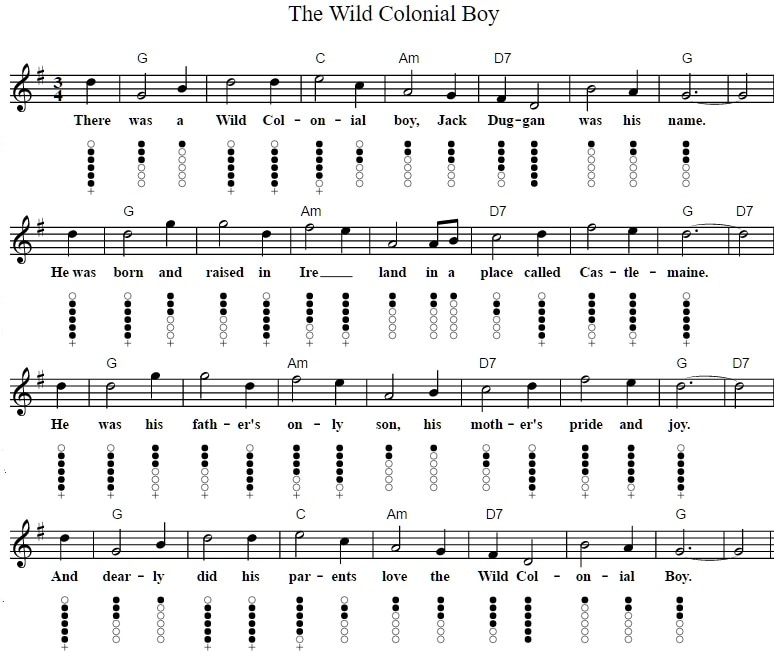
Below is the tin whistle sheet music for The Wild Colonial Boy in the key of G Major.
West Australian version
There was a wild colonial youth, Jack Donahue by name;
Of poor but honest parents he was born in Castlemaine.
He was his father's only hope, his mother's pride and joy,
And dearly did his parents love that wild colonial boy.
Chorus:
Then come all my hearties, well roam the mountains high
Together we will wander, together we will die,
We'll roam beneath the bluegums, and gallop over plains,
For we scorn to live in slavery, bound down with iron chains.
He was scarcely sixteen years of age when he left his father's home,
And through Australia's sunny clime a bushranger did roam,
He robbed the wealthy squatters, their stocks he did destroy,
And a terror to the rich man was the wild colonial boy.
One day as he was riding the mountainside along,
A-listening to the little birds, their pleasant laughing song,
Three mounted troopers met him, Kelly, Davis and Fitzroy,
And thought that they would capture him, the wild colonial boy.
"Surrender now Jack Donahue, you see there's three to one,
Surrender now Jack Donahue, you daring highway man!"
He drew a pistol from his belt and waved it like a toy;
"I'll fight but won't surrender", cried the wild colonial boy.
He fired at trooper Kelly, and brought him to the ground,
And in return from Davis received a mortal wound;
All shattered through the jaws he lay, still firing at Fitzroy,
And that's the way they captured him, the wild colonial
boy.
There was a wild colonial youth, Jack Donahue by name;
Of poor but honest parents he was born in Castlemaine.
He was his father's only hope, his mother's pride and joy,
And dearly did his parents love that wild colonial boy.
Chorus:
Then come all my hearties, well roam the mountains high
Together we will wander, together we will die,
We'll roam beneath the bluegums, and gallop over plains,
For we scorn to live in slavery, bound down with iron chains.
He was scarcely sixteen years of age when he left his father's home,
And through Australia's sunny clime a bushranger did roam,
He robbed the wealthy squatters, their stocks he did destroy,
And a terror to the rich man was the wild colonial boy.
One day as he was riding the mountainside along,
A-listening to the little birds, their pleasant laughing song,
Three mounted troopers met him, Kelly, Davis and Fitzroy,
And thought that they would capture him, the wild colonial boy.
"Surrender now Jack Donahue, you see there's three to one,
Surrender now Jack Donahue, you daring highway man!"
He drew a pistol from his belt and waved it like a toy;
"I'll fight but won't surrender", cried the wild colonial boy.
He fired at trooper Kelly, and brought him to the ground,
And in return from Davis received a mortal wound;
All shattered through the jaws he lay, still firing at Fitzroy,
And that's the way they captured him, the wild colonial
boy.
Archdeacon version
He was a wild colonial boy, Jack Dowling was his name,
Brought up by honest parents, and born in Castlemaine,
He was his father's only son; his mother's pride and joy,
And dearly, dearly did they love this wild colonial boy.
Chorus:
Then come along my hearties, who roam the mountains wide,
Together we will plunder, together we will ride,
We'll ride o'er the mountains and gallop o'er the plains,
Before we'll die in slavery, bound down by iron chains.
In eighteen hundred and sixty three he commenced his wild career,
With a heart that felt no danger and a mind that knew no fear,
He robbed the mail coach on the beach with judge or viceroy,
And a terror to-Australia was the wild colonial boy.
As Jack went out one morning and gaily rode along,
Listening to the mocking birds pretty little song,
Approached three mounted troopers, Kelly, Davis and Fitzroy,
Who rode up and tried to capture him, the wild colonial boy.
"Surrender now Jack Dowling, you outlawed plundering son,
Surrender in the Queen's name for we are three to one".
Jack drew a pistol from his belt and waved the little toy,
Saying "I'll fight but not surrender, I'm the wild colonial boy!"
He shot the trooper Kelly, and laid him on the !ground,
Davis firing in return, received a fatal wound,
He fired another shot, which stretched out poor Fitzroy,
And that was how they captured him, the wild colonial boy.
He was a wild colonial boy, Jack Dowling was his name,
Brought up by honest parents, and born in Castlemaine,
He was his father's only son; his mother's pride and joy,
And dearly, dearly did they love this wild colonial boy.
Chorus:
Then come along my hearties, who roam the mountains wide,
Together we will plunder, together we will ride,
We'll ride o'er the mountains and gallop o'er the plains,
Before we'll die in slavery, bound down by iron chains.
In eighteen hundred and sixty three he commenced his wild career,
With a heart that felt no danger and a mind that knew no fear,
He robbed the mail coach on the beach with judge or viceroy,
And a terror to-Australia was the wild colonial boy.
As Jack went out one morning and gaily rode along,
Listening to the mocking birds pretty little song,
Approached three mounted troopers, Kelly, Davis and Fitzroy,
Who rode up and tried to capture him, the wild colonial boy.
"Surrender now Jack Dowling, you outlawed plundering son,
Surrender in the Queen's name for we are three to one".
Jack drew a pistol from his belt and waved the little toy,
Saying "I'll fight but not surrender, I'm the wild colonial boy!"
He shot the trooper Kelly, and laid him on the !ground,
Davis firing in return, received a fatal wound,
He fired another shot, which stretched out poor Fitzroy,
And that was how they captured him, the wild colonial boy.
A Gladys Scrivener version
In Dublin Town I was brought up, in that city of great fame,
My decent friends and parents they will tell to you the same;
It was all for five hundred pounds I was sent across the main,
For seven long years in New South Wales to wear a convict's chain.
Chorus:
Now come along my hearties, we'll roam the mountainside,
Together we will plunder and together we will die,
We'll wander o'er the valleys and we'll gallop o'er the plains,
For we scorn to live in slavery, bound down in iron chains.
I'd scarce been there twelve months or more upon the Australian shore,
When I took to the highway as I'd oft-times done before,
There was me and Jacky Underwood, and Webber and Walmsley too,
These were the true associates of bold Jack Donahoe.
Now Donahoe was taken all for a notorious crime,
And sentenced to be hung upon the gallows tree so high,
But when they came to Sydney gaol he left them in a stew
And when they came to call the roll they missed Jack Donahoe.
Now Donahoe made his escape, to the bush he went straightway,
The people they were all afraid to travel night or day,
For every day the newspapers had something published new,
Concerning this dauntless hero the bold Jack Donahoe.
As Donahoe was cruising one summer's afternoon,
Listening to the mocking birds, their pretty laughing tune,
When the sergeant of the horse police discharged his carabine,
And called aloud on Donahoe to fight or to resign.
"Resign to you, you cowardly dogs, a thing I ne'er will do,
For I'll fight this night with all my might", cried bold Jack Donahoe,
"I'd rather roam these hills and dales like a wolf or kangaroo,
Than work one hour for government", cried bold Jack Donahoe.
He fought six rounds with the horse police until the fatal ball,
Which pierced his heart and made him start, caused Donahoe to fall,
And as he closed his mournful eyes, he bade this world adieu,
Saying, "Convicts all, both large and small, say prayers for Donahoe".
In Dublin Town I was brought up, in that city of great fame,
My decent friends and parents they will tell to you the same;
It was all for five hundred pounds I was sent across the main,
For seven long years in New South Wales to wear a convict's chain.
Chorus:
Now come along my hearties, we'll roam the mountainside,
Together we will plunder and together we will die,
We'll wander o'er the valleys and we'll gallop o'er the plains,
For we scorn to live in slavery, bound down in iron chains.
I'd scarce been there twelve months or more upon the Australian shore,
When I took to the highway as I'd oft-times done before,
There was me and Jacky Underwood, and Webber and Walmsley too,
These were the true associates of bold Jack Donahoe.
Now Donahoe was taken all for a notorious crime,
And sentenced to be hung upon the gallows tree so high,
But when they came to Sydney gaol he left them in a stew
And when they came to call the roll they missed Jack Donahoe.
Now Donahoe made his escape, to the bush he went straightway,
The people they were all afraid to travel night or day,
For every day the newspapers had something published new,
Concerning this dauntless hero the bold Jack Donahoe.
As Donahoe was cruising one summer's afternoon,
Listening to the mocking birds, their pretty laughing tune,
When the sergeant of the horse police discharged his carabine,
And called aloud on Donahoe to fight or to resign.
"Resign to you, you cowardly dogs, a thing I ne'er will do,
For I'll fight this night with all my might", cried bold Jack Donahoe,
"I'd rather roam these hills and dales like a wolf or kangaroo,
Than work one hour for government", cried bold Jack Donahoe.
He fought six rounds with the horse police until the fatal ball,
Which pierced his heart and made him start, caused Donahoe to fall,
And as he closed his mournful eyes, he bade this world adieu,
Saying, "Convicts all, both large and small, say prayers for Donahoe".
Paterson version
'Twas of a valiant highwayman and outlaw of disdain,
Who'd scorn to live in slavery or wear a convict's chain;
His name it was Jack Donahoe of courage and renown -
He'd scorn to live in slavery or humble to the Crown.
This bold undaunted highwayman, as you may understand,
Was banished for his natural life from Erin's happy land.
In Dublin City of renown, where his first breath he drew,
It's there they titled him the brave and bold Jack Donahoe.
He scarce had been a twelve-month on the Australian shore,
When he took to the highway, as oft he had before.
Brave Macnamara, Underwood, Webber and Walmsley too,
These were the four associates of bold Jack Donahoe.
As Jack and his companions roved out one afternoon,
Not thinking that the pains of death would overcome so soon,
To their surprise five horse police appeared all in their view,
And in quick time they did advance to take Jack Donahoe.
Come, come, you cowardly rascals, oh do not run away!
We'll fight them man to man, my boys, their number's only three;
For I'd rather range the bush around, like dingo or kangaroo,
Than work one hour for Government," said bold Jack Donahoe.
"Oh no," said cowardly Walmsley, "to that I won't agree;
I see they're still advancing us ~ their number's more than three.
And if we wait we'll be too late, the battle we will rue."
"Then begone from me, you cowardly dog," replied Jack Donahoe.
The Sergeant of the horse police discharged his carabine,
And called aloud to Donahoe "Will you fight or resign,"
"Resign, no, no! I never will, unto your cowardly crew,
For today I'll fight with all my might," cried bold Jack Donahoe.
The Sergeant then, in a hurry his party to divide,
Placed one to fire in front of him, and another on each side;
The Sergeant and the Corporal, they both fired too,
Till the fatal ball had pierced the heart of bold Jack Donahoe.
Six rounds he fought those horse police before the fatal ball,
Which pierced his heart with cruel smart, caused Donahoe to fall;
And as he closed his mournful eyes he bade this world adieu,
Saying, "Good people all, pray for the soul of poor Jack Donahoe".
There were Freincy, Grant, bold Robin Hood, Brennan and O'Hare;
With Donahoe this highwayman none of them could compare.
But now he's gone to Heaven, I hope, with saints and angels too
May the Lord have mercy on the soul of brave Jack Donahoe.
'Twas of a valiant highwayman and outlaw of disdain,
Who'd scorn to live in slavery or wear a convict's chain;
His name it was Jack Donahoe of courage and renown -
He'd scorn to live in slavery or humble to the Crown.
This bold undaunted highwayman, as you may understand,
Was banished for his natural life from Erin's happy land.
In Dublin City of renown, where his first breath he drew,
It's there they titled him the brave and bold Jack Donahoe.
He scarce had been a twelve-month on the Australian shore,
When he took to the highway, as oft he had before.
Brave Macnamara, Underwood, Webber and Walmsley too,
These were the four associates of bold Jack Donahoe.
As Jack and his companions roved out one afternoon,
Not thinking that the pains of death would overcome so soon,
To their surprise five horse police appeared all in their view,
And in quick time they did advance to take Jack Donahoe.
Come, come, you cowardly rascals, oh do not run away!
We'll fight them man to man, my boys, their number's only three;
For I'd rather range the bush around, like dingo or kangaroo,
Than work one hour for Government," said bold Jack Donahoe.
"Oh no," said cowardly Walmsley, "to that I won't agree;
I see they're still advancing us ~ their number's more than three.
And if we wait we'll be too late, the battle we will rue."
"Then begone from me, you cowardly dog," replied Jack Donahoe.
The Sergeant of the horse police discharged his carabine,
And called aloud to Donahoe "Will you fight or resign,"
"Resign, no, no! I never will, unto your cowardly crew,
For today I'll fight with all my might," cried bold Jack Donahoe.
The Sergeant then, in a hurry his party to divide,
Placed one to fire in front of him, and another on each side;
The Sergeant and the Corporal, they both fired too,
Till the fatal ball had pierced the heart of bold Jack Donahoe.
Six rounds he fought those horse police before the fatal ball,
Which pierced his heart with cruel smart, caused Donahoe to fall;
And as he closed his mournful eyes he bade this world adieu,
Saying, "Good people all, pray for the soul of poor Jack Donahoe".
There were Freincy, Grant, bold Robin Hood, Brennan and O'Hare;
With Donahoe this highwayman none of them could compare.
But now he's gone to Heaven, I hope, with saints and angels too
May the Lord have mercy on the soul of brave Jack Donahoe.
here’s a full background and analysis of the legendary Australian folk song “The Wild Colonial Boy.” It’s one of the best-known bushranger ballads and remains a key part of both Australian and Irish folk traditions.
🇦🇺 The Wild Colonial BoyType: Traditional Australian ballad (with Irish roots)
Origin: Early–mid 19th century
Themes: Rebellion, freedom, heroism, and outlaw life
Setting: Colonial Australia
Notable figures linked to the song: Jack Doolan (or Duggan / Donahue) — a semi-legendary bushranger
🎵 Overview“The Wild Colonial Boy” is one of Australia’s most enduring folk songs, telling the story of a young outlaw who defies British colonial authority.
It celebrates the rebellious spirit of the Irish immigrants who came to Australia — many of whom were convicts, settlers, or descendants of transported Irish rebels.
Like many bush ballads, it’s sung with sympathy for the outlaw, portraying him as brave, noble, and wronged by an unjust system — a recurring theme in both Irish and Australian song traditions.
📜 Typical Lyrics (Common Version)There was a wild colonial boy,
Jack Doolan was his name,
He was born and bred in Ireland,
In a place called Castlemaine.
He was his father’s only son,
His mother’s pride and joy,
And dearly did his parents love
The wild colonial boy.
At the early age of sixteen years
He left his native home,
And to Australia’s sunny shores
He was inclined to roam.
He robbed the wealthy squatters,
Their stock he did destroy,
A terror to Australia
Was the wild colonial boy.
One morning on the prairie
As Jack he rode along,
A-listening to the mockingbird
Singing a cheerful song,
Three mounted troopers rode along,
Kelly, Davis, and Fitzroy,
They all set out to capture him,
The wild colonial boy.
“Surrender now, Jack Doolan,
You see there’s three to one;
Surrender now, Jack Doolan,
You daring highwayman!”
He drew two pistols from his belt
And proudly waved them high,
“I’ll fight, but not surrender,”
Said the wild colonial boy.
He fired at Trooper Kelly
And brought him to the ground,
And in return from Davis
Received a mortal wound.
All shattered through the jaws he lay,
Still firing at Fitzroy,
And that’s the way they captured him --
The wild colonial boy.
🕯️ Meaning and SymbolismTheme Explanation Rebellion Jack Doolan represents the anti-authoritarian spirit of colonial Ireland and Australia.
Irish Identity Many early versions mention Ireland directly — showing how Irish convict and settler culture shaped Australian folklore.
Heroic Outlaw Like Robin Hood or Ned Kelly, the “wild colonial boy” robs the rich and defies the law in the name of justice.
Colonial Hardship Reflects resentment toward British rule, unfair treatment of the poor, and social inequality.
Tragic Fate The song often ends with his capture or death — symbolizing the price of rebellion.
🏞️ Historical Context
🎶 Musical Characteristics
🎤 Notable RecordingsArtist Notes The Clancy Brothers & Tommy Makem Famous rousing Irish version — revived the song worldwide in the 1960s.
The Dubliners Performed it in traditional style with banjo and harmony.
Slim Dusty Australian version — gave it a bush ballad feel.
Johnny McEvoy Smooth Irish folk rendition, slower and more reflective.
The Pogues Performed a lively pub-style version during their tours.
🪶 VariationsThere are many regional and lyrical variants of the song.
Some versions are called:
🇮🇪🇦🇺 Irish–Australian Connection“The Wild Colonial Boy” is one of the best examples of how Irish musical heritage took root in Australia.
It blends:
🎵 SummaryFeature Details Title: The Wild Colonial Boy
Type: Irish–Australian folk ballad
Origin:19th century
Themes: Rebellion, outlaw life, freedom
Setting: Colonial Australia
Key Figure: Jack Doolan / Duggan / Donahue
Mood: Heroic, tragic, patriotic
Symbolism: Resistance to authority, Irish pride in exile
Legacy: One of the most famous bushranger ballads ever written
✍️ Final Reflection“The Wild Colonial Boy” captures the soul of the Irish diaspora in Australia — defiant, proud, and unwilling to submit.
It’s a song that celebrates courage in the face of oppression and the eternal human yearning for freedom.
“I’ll fight, but not surrender,” said the wild colonial boy.
A line that continues to echo through both Irish and Australian hearts alike. 💚🇦🇺
🇦🇺 The Wild Colonial BoyType: Traditional Australian ballad (with Irish roots)
Origin: Early–mid 19th century
Themes: Rebellion, freedom, heroism, and outlaw life
Setting: Colonial Australia
Notable figures linked to the song: Jack Doolan (or Duggan / Donahue) — a semi-legendary bushranger
🎵 Overview“The Wild Colonial Boy” is one of Australia’s most enduring folk songs, telling the story of a young outlaw who defies British colonial authority.
It celebrates the rebellious spirit of the Irish immigrants who came to Australia — many of whom were convicts, settlers, or descendants of transported Irish rebels.
Like many bush ballads, it’s sung with sympathy for the outlaw, portraying him as brave, noble, and wronged by an unjust system — a recurring theme in both Irish and Australian song traditions.
📜 Typical Lyrics (Common Version)There was a wild colonial boy,
Jack Doolan was his name,
He was born and bred in Ireland,
In a place called Castlemaine.
He was his father’s only son,
His mother’s pride and joy,
And dearly did his parents love
The wild colonial boy.
At the early age of sixteen years
He left his native home,
And to Australia’s sunny shores
He was inclined to roam.
He robbed the wealthy squatters,
Their stock he did destroy,
A terror to Australia
Was the wild colonial boy.
One morning on the prairie
As Jack he rode along,
A-listening to the mockingbird
Singing a cheerful song,
Three mounted troopers rode along,
Kelly, Davis, and Fitzroy,
They all set out to capture him,
The wild colonial boy.
“Surrender now, Jack Doolan,
You see there’s three to one;
Surrender now, Jack Doolan,
You daring highwayman!”
He drew two pistols from his belt
And proudly waved them high,
“I’ll fight, but not surrender,”
Said the wild colonial boy.
He fired at Trooper Kelly
And brought him to the ground,
And in return from Davis
Received a mortal wound.
All shattered through the jaws he lay,
Still firing at Fitzroy,
And that’s the way they captured him --
The wild colonial boy.
🕯️ Meaning and SymbolismTheme Explanation Rebellion Jack Doolan represents the anti-authoritarian spirit of colonial Ireland and Australia.
Irish Identity Many early versions mention Ireland directly — showing how Irish convict and settler culture shaped Australian folklore.
Heroic Outlaw Like Robin Hood or Ned Kelly, the “wild colonial boy” robs the rich and defies the law in the name of justice.
Colonial Hardship Reflects resentment toward British rule, unfair treatment of the poor, and social inequality.
Tragic Fate The song often ends with his capture or death — symbolizing the price of rebellion.
🏞️ Historical Context
- The song likely originated in the early 1800s, around the time when many Irish convicts and settlers were sent to Australia after uprisings like the 1798 Rebellion.
- It may have evolved from earlier Irish ballads about rebels such as Bold Jack Donahue, an Irish-born bushranger who became a folk hero in New South Wales and was killed in 1830.
- Over time, singers changed his name — from Donahue to Duggan or Doolan — and shifted details to reflect local settings (Castlemaine, Bendigo, or “Australia’s sunny shore”).
🎶 Musical Characteristics
- Meter: 4/4 (common time)
- Tempo: Moderate, often sung like a march or storytelling ballad
- Mode: Major key, often G major or D major
- Style: Narrative ballad — steady rhythm, simple melody, strong chorus
- Common Instruments:
- Guitar or banjo
- Fiddle
- Accordion or concertina
- Bodhrán (in Irish versions)
- Guitar or banjo
🎤 Notable RecordingsArtist Notes The Clancy Brothers & Tommy Makem Famous rousing Irish version — revived the song worldwide in the 1960s.
The Dubliners Performed it in traditional style with banjo and harmony.
Slim Dusty Australian version — gave it a bush ballad feel.
Johnny McEvoy Smooth Irish folk rendition, slower and more reflective.
The Pogues Performed a lively pub-style version during their tours.
🪶 VariationsThere are many regional and lyrical variants of the song.
Some versions are called:
- Bold Jack Donahue
- The Wild Colonial Lad
- Jack Duggan’s Song
🇮🇪🇦🇺 Irish–Australian Connection“The Wild Colonial Boy” is one of the best examples of how Irish musical heritage took root in Australia.
It blends:
- Irish ballad structure and melody
- Australian landscape and slang
- Themes of rebellion and exile
🎵 SummaryFeature Details Title: The Wild Colonial Boy
Type: Irish–Australian folk ballad
Origin:19th century
Themes: Rebellion, outlaw life, freedom
Setting: Colonial Australia
Key Figure: Jack Doolan / Duggan / Donahue
Mood: Heroic, tragic, patriotic
Symbolism: Resistance to authority, Irish pride in exile
Legacy: One of the most famous bushranger ballads ever written
✍️ Final Reflection“The Wild Colonial Boy” captures the soul of the Irish diaspora in Australia — defiant, proud, and unwilling to submit.
It’s a song that celebrates courage in the face of oppression and the eternal human yearning for freedom.
“I’ll fight, but not surrender,” said the wild colonial boy.
A line that continues to echo through both Irish and Australian hearts alike. 💚🇦🇺