Go On Home British Soldiers Lyrics And Guitar Chords
The easy to play guitar chords are in chordpro style. This Irish rebel [ pro I.R.A ] song was written by Tommy Skelly. Recorded by The Wolfe Tones and Gary 'Eire' Og'. I have given the guitar chords in two different keys. To play along with The Wolfe Tones play in the key of D major as that's the key Noel Nagle is singing in the youtube video. The sheet music and tin whistle notes are included. Celtic fans sing / chant this song ''the i the i the ira'' at football games along with many other rebel / I.R.A. songs. The Wolfe Tones play the song in the key of D. Gary Og also recorded many more ballads on the site including Irish Soldier Laddie Song .
Lyrics And Easy Guitar Chords In The Key Of G Major
Chorus]
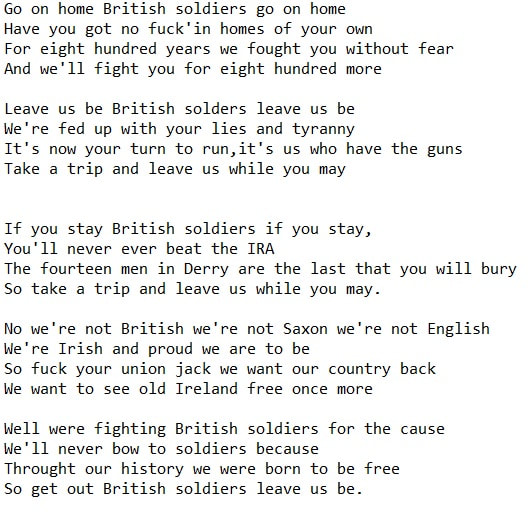
Go[G] on home British soldiers go on home
Have you[C] got no fuck'in[G] homes of your[D] own
For[C] eight hundred years we[G] fought you without[Em] fear
And we'll[G] fight you for[D] eight hundred[G] more
Leave us be British solders leave us be
We're fed up with your lies and tyranny
It's now your turn to run,it's us who have the guns
Take a trip and leave us while you may
If you stay British soldiers if you stay,
You'll never ever beat the IRA
The fourteen men in Derry are the last that you will bury
So take a trip and leave us while you may.
No we're not British we're not Saxon we're not English
We're Irish and proud we are to be
So fuck your union jack we want our country back
We want to see old Ireland free once more
Well were fighting British soldiers for the cause
We'll never bow to soldiers because
Throught our history we were born to be free
So get out British soldiers leave us be.
Chorus]
Go[G] on home British soldiers go on home
Have you[C] got no fuck'in[G] homes of your[D] own
For[C] eight hundred years we[G] fought you without[Em] fear
And we'll[G] fight you for[D] eight hundred[G] more
Leave us be British solders leave us be
We're fed up with your lies and tyranny
It's now your turn to run,it's us who have the guns
Take a trip and leave us while you may
If you stay British soldiers if you stay,
You'll never ever beat the IRA
The fourteen men in Derry are the last that you will bury
So take a trip and leave us while you may.
No we're not British we're not Saxon we're not English
We're Irish and proud we are to be
So fuck your union jack we want our country back
We want to see old Ireland free once more
Well were fighting British soldiers for the cause
We'll never bow to soldiers because
Throught our history we were born to be free
So get out British soldiers leave us be.
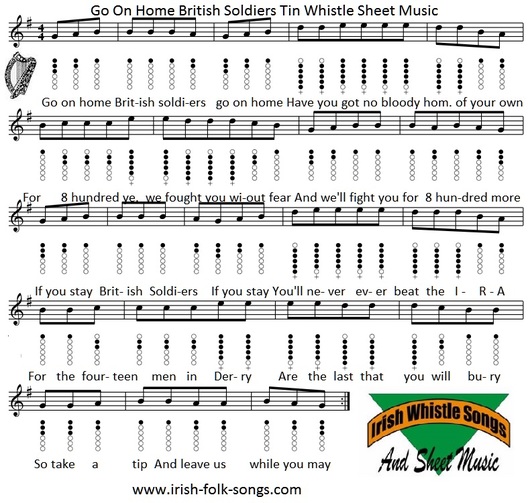
Go On Home British Soldiers Sheet Music
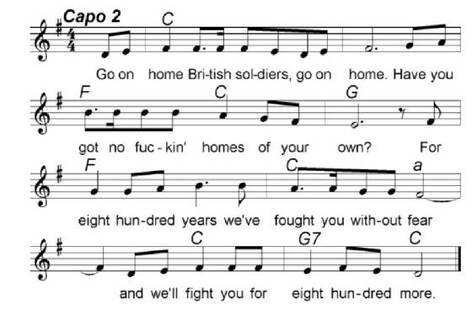
The above piece of sheet music is one version of this song in the key of C. Below is another version in G.
Notes for banjo/mandolin and tin whistle (Key = G)
G A B B B B A G A B
Go on home British soldiers go on home
d d e e e e d d B A
Have you got no bloody homes of your own
B c c c e e d d d c B
For eight hundred years we fought you without fear
G A B B B A B A G
And we'll fight you for eight hundred more
G A B B B B A G A B
If you stay British Soldiers If you stay
d e e e e d d d B A
You'll never ever beat the I-R-A
B B c c c c e e
For the fourteen men in Derry
e e d d d c B B
Are the last that you will bury
G G A B B A A B A G
So take a tip And leave us while you may
[ The notes in CAPITAL letters are the low one's as far as the B, and the notes past the B in small letters are the high ones. ] The above letter notes and the tin whistle sheet music is in the key that Shebeen play the song in.
G A B B B B A G A B
Go on home British soldiers go on home
d d e e e e d d B A
Have you got no bloody homes of your own
B c c c e e d d d c B
For eight hundred years we fought you without fear
G A B B B A B A G
And we'll fight you for eight hundred more
G A B B B B A G A B
If you stay British Soldiers If you stay
d e e e e d d d B A
You'll never ever beat the I-R-A
B B c c c c e e
For the fourteen men in Derry
e e d d d c B B
Are the last that you will bury
G G A B B A A B A G
So take a tip And leave us while you may
[ The notes in CAPITAL letters are the low one's as far as the B, and the notes past the B in small letters are the high ones. ] The above letter notes and the tin whistle sheet music is in the key that Shebeen play the song in.
Here's the list of Irish rebel songs sheet music / tin whistle notes in that ebook.
The price is €8.90. You'll be diverted to the download page after payment.
Any problems please let me know. [email protected]
The price is €8.90. You'll be diverted to the download page after payment.
Any problems please let me know. [email protected]
Go On Home British Soldiers Tin Whistle Notes
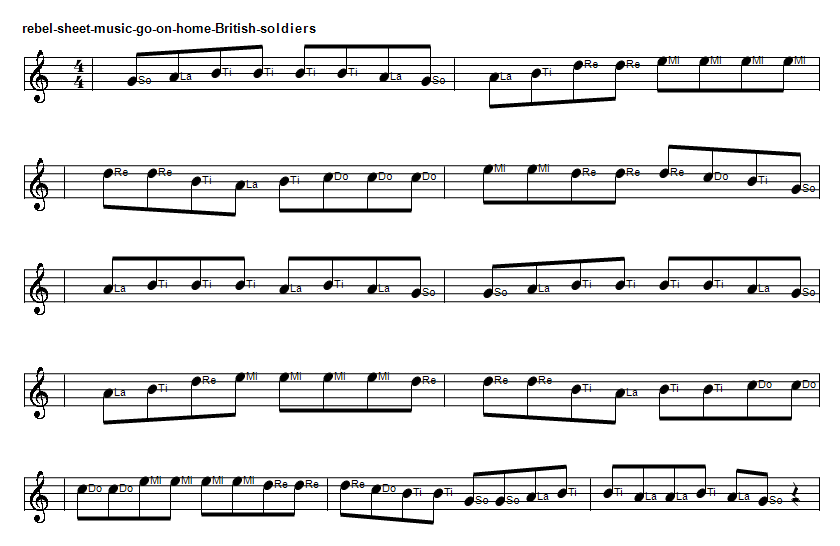
Rebel sheet music for Irish song go on home British Soldiers in solfege, do re mi format.
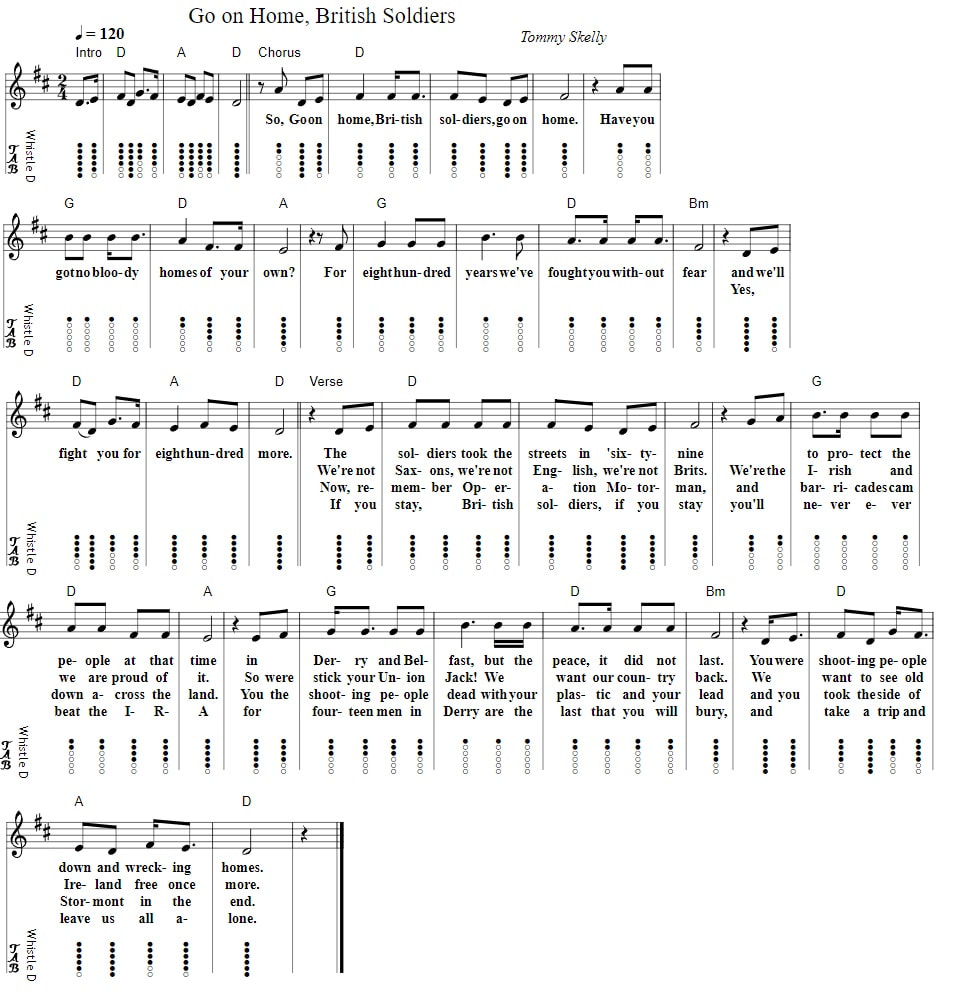
Alternative version of the sheet music below. Chords included.
Below is the ebook list of Irish Folk Songs with guitar chords
in 3 keys. Price €8.90 and I'll email the ebook after purchase .
The chords are suited to ukulele, banjo or mandolin also.
Martin
in 3 keys. Price €8.90 and I'll email the ebook after purchase .
The chords are suited to ukulele, banjo or mandolin also.
Martin
☘️ Go On Home British Soldiers
Type: Irish rebel song
Genre: Political folk / ballad
Language: English
Theme: Anti-occupation, nationalism, identity, defiance
🎵 Overview
“Go On Home British Soldiers” is one of the most well-known and provocative Irish rebel songs to emerge from The Troubles — the conflict in Northern Ireland that spanned from the late 1960s through the 1990s.
It’s a protest song written from the perspective of an Irish nationalist, expressing defiance against British military presence in Northern Ireland and affirming the Irish people’s right to self-determination and unity.
The song became an anthem for Irish republicans, much like The Men Behind the Wire or Come Out Ye Black and Tans. While deeply controversial for its political tone, it remains an important piece of modern Irish folk tradition.
📜 Typical Lyrics
(Most common version, as sung by The Wolfe Tones)
Go on home, British soldiers, go on home,
Have you got no bloody homes of your own?
For eight hundred years we’ve fought you without fear,
And we’ll fight you for eight hundred more.
If you stay, British soldiers, if you stay,
You’ll never ever beat the IRA.
We’ll fight you till we can’t fight any more,
Till you go to hell and leave our shore.
We’re not British, we’re not English,
We’re not Saxon, we’re not Scots.
But we’re Irish, and proud we are to be,
So f** your Union Jack, we want our country back,
And we want to see old Ireland free.*
(Later verses vary between versions, some being more moderate or more militant.)
⚙️ Musical Characteristics
Time Signature: 4/4 (march tempo)
Key: Typically in G major or D major
Structure: Verse–chorus song, designed for audience participation
Mood: Defiant, passionate, emotional
Instrumentation: Usually performed with acoustic guitar, tin whistle, and bodhrán; sometimes with full folk-rock backing (as in The Wolfe Tones version).
Its simple, repetitive melody allows large groups to sing along — typical of Irish protest songs and ballads meant for public performance or marches.
⚔️ Historical Background
The song originated during the early years of The Troubles (1968–1972), a period of violent and political conflict over the status of Northern Ireland.
During this time:
British troops were deployed in Northern Ireland (Operation Banner, 1969–2007).
Nationalists (mostly Catholic) called for civil rights and Irish unification.
Unionists (mostly Protestant) wanted Northern Ireland to remain part of the UK.
“Go On Home British Soldiers” emerged as a grassroots response to the military occupation, particularly in nationalist areas such as Belfast and Derry.
It captures the anger and resentment of communities that viewed British troops as an occupying force rather than peacekeepers.
🪕 Recordings and Artists
Artist Version / Notes
The Wolfe Tones The most famous and enduring version. Recorded in the 1970s; often performed live.
The Irish Brigade Recorded a raw, more militant version emphasizing resistance.
Various pub singers and session musicians The song is widely known across Irish pubs and gatherings, especially among republican audiences.
🇮🇪 Themes and Meaning
Theme Description
Resistance and Defiance The song proudly declares that the Irish will never submit to British rule, referencing centuries of resistance.
National Identity Rejects all British or colonial identity, asserting Irish pride and sovereignty.
Historical Continuity Refers to 800 years of struggle — from Norman invasion to The Troubles.
Protest and Solidarity Serves as a rallying cry for nationalist unity and community resilience.
The lyrics express anger, pride, and determination, but also a collective identity shaped by historical oppression.
⚖️ Controversy and Context
“Go On Home British Soldiers” is one of the most controversial Irish rebel songs.
It has been criticized for being anti-British or sectarian, especially when performed in politically sensitive contexts.
However, many singers and listeners view it as:
A historical protest ballad, rather than an incitement to violence.
A reflection of real emotion felt during years of occupation and conflict.
A folk chronicle — documenting a particular time, place, and feeling.
Because of its political content, the song has been banned or discouraged on radio and TV, though it remains popular in folk circles and among republican communities.
💬 Cultural Role
Like many Irish rebel songs, Go On Home British Soldiers serves both as music and historical memory.
It is often sung alongside:
The Men Behind the Wire
Come Out Ye Black and Tans
The Broad Black Brimmer
A Nation Once Again
Together, these songs form a musical chronicle of resistance, preserving the emotions of Ireland’s long and complex struggle for independence and unity.
🪶 Summary
Feature Details
Title: Go On Home British Soldiers
Type: Irish rebel / protest song
Origin: Northern Ireland, c. 1980
Key Themes: Anti-occupation, Irish identity, defiance
Mood: Proud, confrontational, political
Associated Artists: The Wolfe Tones, The Irish Brigade
Cultural Context: The Troubles — nationalist resistance
Legacy: A defining song of the Irish republican folk tradition
⚡ In Essence
“Go On Home British Soldiers” is more than a rebel chant — it’s a snapshot of a turbulent time, capturing the frustration, nationalism, and pride of the Irish people in the face of conflict.
Whether seen as protest, propaganda, or historical expression, it remains a powerful example of how folk music becomes the voice of political struggle.
“We’re not British, we’re not English,
We’re not Saxon, we’re not Scots,
But we’re Irish, and proud we are to be --
So go on home British soldiers, go on home.”
